Pilates vs yoga, and how to choose between the two
Some links in this story go to Amazon and to other shops, and we may earn a commission from them. As an Amazon Associate I earn from qualifying purchases.
Pilates vs yoga comes down to purpose. Pilates is a 20th-century exercise system built to strengthen the body evenly, with the trunk at its centre and a small number of precise, controlled repetitions. Yoga is a far older Indian tradition in which the physical postures are one part of a wider practice that also covers breath, meditation and ethics. Both build strength, flexibility and body awareness, and in calorie terms most classes of either sit closer together than people expect.
The real differences show up in the details: how you breathe, how long you stay in a position, what equipment you meet and what the teacher is watching for. This piece sets them side by side, with the figures from the Compendium of Physical Activities, a quick word on barre, and some honest help with choosing.
Where each one comes from
Joseph Pilates was born in 1883 in Mönchengladbach, Germany. He spent the First World War interned by the British as an enemy alien, moved to New York in the 1920s and ran a studio there with his partner Clara for decades. He called his method Contrology and set out its argument in two short books, Your Health (1934) and Return to Life Through Contrology (1945). His famous definition of the method, complete coordination of body, mind and spirit, is less of a slogan than it looks, as our piece on that phrase explains. He died in New York in 1967.
Yoga's roots run back many centuries in India, through texts such as the Yoga Sutras attributed to Patanjali and the later hatha yoga manuals. In those traditions the postures, or asana, are one strand among several, alongside breath practice, meditation and a way of living. Much of the posture-led yoga taught in Western studios took its present shape in the 20th century, and plenty of teachers keep the wider tradition close. When most people compare yoga vs Pilates, though, they mean the classes they could book next week, and that is what I compare here.
What each is trying to do
A Pilates session aims to make the body strong and supple evenly, so that no part does all the work while another sits idle. Movements are usually done 5 to 10 times, with attention on how the spine bends and lengthens, how the pelvis stays steady, and how one exercise flows into the next. The abdominals work almost all the time, often while the arms and legs move.
Yoga varies far more by style. A hatha class might hold each posture for five slow breaths and finish with several minutes lying still. A vinyasa class links postures into a continuous flow timed to the breath. Power yoga pushes that flow towards a workout. Across styles, yoga tends to spend longer at the end of your flexibility range, more time balancing on one leg or on the hands, and more time on stillness and attention.
Breath
Pilates teaches lateral breathing: you breathe wide into the back and sides of the ribs while the deep abdominals stay gently drawn in, and you usually breathe out on the effort. The explainer on lateral breathing covers the mechanics.
Yoga classes usually ask you to breathe through the nose, and flow styles often use ujjayi, a slow breath with a soft sound made by slightly narrowing the throat. The breath sets the pace of the movement. Many classes also include breathing practices done sitting still, and the belly is often allowed to soften and fill in a way a Pilates teacher would not ask for mid-exercise. Neither approach is wrong; they serve different jobs.
Equipment
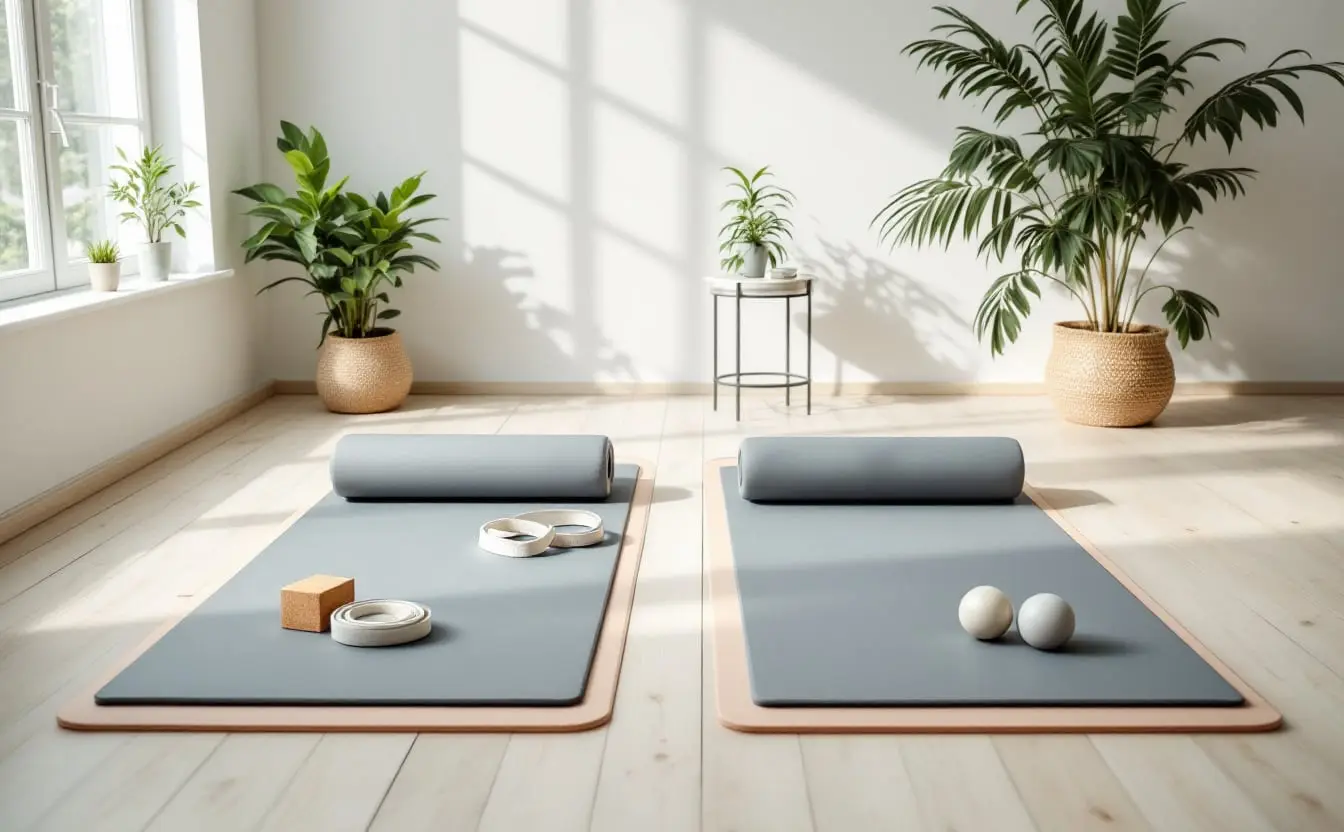
Mat Pilates needs a mat, ideally a thicker one of about half an inch (10 to 15 mm) for rolling on the spine, and sometimes a ring, a small ball or a band. Studio Pilates adds spring-loaded apparatus: the reformer, the trapeze table, the chair and the barrels. The springs can make an exercise harder or, just as usefully, easier.
Yoga uses a thinner, stickier mat of about a quarter inch or less (4 to 6 mm), so your hands and feet grip in standing postures. Blocks, straps, bolsters and blankets bring the floor closer or support you in longer holds.
Intensity and calories
The 2024 Adult Compendium of Physical Activities gives these values in METs (multiples of resting energy use): Pilates, traditional mat 1.8; Pilates, general 2.8; hatha yoga 2.3; vinyasa yoga 2.7; power yoga 4.0. Anything under 3 counts as light, 3 to 5.9 as moderate. To turn METs into calories, the standard formula is kcal per minute = MET × 3.5 × body mass in kg ÷ 200.
For someone weighing 155 lb (70.3 kg), each MET is worth 3.5 × 70.3 ÷ 200 = 1.23 calories a minute, or about 73.8 calories over an hour. A 60-minute general Pilates class therefore comes to 2.8 × 3.5 × 70.3 ÷ 200 = 3.44 calories a minute, about 207 in total.
| Class, 60 minutes at 155 lb (70.3 kg) | METs | Band | Calories, about |
|---|---|---|---|
| Pilates, traditional mat | 1.8 | Light | 133 |
| Hatha yoga | 2.3 | Light | 170 |
| Vinyasa yoga | 2.7 | Light | 199 |
| Pilates, general | 2.8 | Light | 207 |
| Power yoga | 4.0 | Moderate | 295 |
The gap between styles within each practice is bigger than the gap between Pilates and yoga. A vinyasa class and a general Pilates class are almost level. The Compendium has no separate reformer value, so a fast, circuit-style reformer class will likely burn more than the general figure, and published measurements of Pilates vary widely with pace and exercise choice. To run your own weight and minutes, use the calories burned calculator.
Pilates vs yoga at a glance
| Pilates | Yoga | |
|---|---|---|
| Origins | Joseph Pilates, Germany and New York, early 20th century | India, many centuries; studio posture styles largely 20th century |
| Main aim | Even strength, trunk control, a mobile spine | Varies by style: flexibility, balance, strength, calm |
| Typical work | 5 to 10 controlled reps in a set order | Postures held for several breaths, or linked in flows |
| Breath | Lateral, out on the effort | Through the nose, often ujjayi in flow classes |
| Equipment | Mat, small props, spring apparatus | Mat, blocks, straps, bolsters |
| Compendium METs | 1.8 to 2.8 | 2.3 (hatha) to 4.0 (power) |
| Class feel | Precise, lots of cueing, brisk | From slow and restorative to hot and fast |
Is Pilates or yoga better for weight loss?
Neither is a big calorie burner, and the honest answer is that the better one is the one you keep doing. Power yoga uses the most energy of the five classes above, and it is still only moderate intensity. Weight change depends mostly on what you eat and on your total activity across the week, including walking. What both practices can add is strength: Pilates loads the trunk, hips and shoulders against body weight or springs, and the stronger yoga styles do something similar with long holds. Either can count towards the muscle-strengthening activity the US and UK guidelines ask for on at least two days a week, provided the work is genuinely hard by the end.
Barre vs Pilates
Barre is usually traced to the dancer Lotte Berk, who opened a studio in London at the end of the 1950s. A modern barre class borrows the ballet barre for balance and mixes in small, fast pulsing movements, light hand weights, high repetitions and some Pilates-style abdominal work, often to loud music. Pilates moves through a fuller range, with fewer and slower repetitions and much more attention on how the spine articulates. Barre tends to feel like a muscular endurance class with a dancer's accent; Pilates feels more like a technical strength class. The Compendium figures above do not include barre, so I will not guess at its calories.
Can you do both?
Yes, and they sit well together. Pilates gives you trunk control and strength in motion; yoga gives you longer holds, more time at the end of your range and a practice of stillness. A sensible week might hold two Pilates sessions, one yoga class and some brisk walks on the days between.
Two small things help. Expect different cues for the same body part, especially around the belly and the breath, and treat each as a skill for its own setting. And if you are new to both, start one at a time for a month, so you know which one your knees or your neck are complaining about. If you want to try Pilates at home before booking a class, the wall Pilates exercises are a gentle way in.
Who suits which
Pilates may suit you better if:
- you want trunk strength and control more than deep flexibility
- you like precise instructions and a set order of exercises
- holding still for long periods leaves you restless
- you are curious about spring apparatus such as the reformer
Yoga may suit you better if:
- you want to work on flexibility and balance in longer holds
- breath practice, relaxation or meditation appeal to you
- you like the choice between a slow, quiet class and a fast, sweaty one
- the wider tradition behind the postures interests you
If you are pregnant, have osteoporosis or are recovering from an injury, look for a qualified teacher who can see you in person. Deep forward folds in yoga and rolling exercises in Pilates both need adapting for some bodies.
Book one class of each within the same fortnight, take the same mat to both, and notice which one you are still thinking about on the walk home.