Lateral breathing in Pilates and how to practise it
Somewhere in your first few Pilates classes, a teacher will ask you to breathe into the sides and back of your ribcage while keeping your stomach gently drawn in. Most people find this odd. We are often told to breathe into the belly to relax, and here is someone asking for the opposite.
Both instructions make sense, because they do different jobs. Lateral breathing, sometimes called thoracic or intercostal breathing, is a way of filling the lungs while keeping some support around the middle of the body. It is a tool for moving, not a superior way of breathing all day. Once you understand the mechanics it stops feeling strange, and after a few weeks most people stop thinking about it at all.
What happens when you breathe
The main breathing muscle is the diaphragm, a dome-shaped sheet of muscle that sits under the lungs and attaches to the inside of the lower ribs, the base of the breastbone and the lumbar spine. When it contracts, the dome flattens and moves down, the space in the chest gets bigger, and air flows in. When it relaxes, the dome rises again and air flows out.
As the diaphragm descends, it presses on the contents of the abdomen. Something has to give. If the abdominal wall is soft, the belly moves out, which is the familiar rise and fall of relaxed breathing. If the abdominal wall stays gently engaged, more of the expansion goes into the ribcage instead. The muscles between the ribs, the intercostals, help here: the lower ribs swing outwards to the sides a little like the handle of a bucket being lifted, while the upper ribs and breastbone move forward and up.
Breathing out at rest is mostly passive, the lungs and ribcage simply springing back. A fuller, more forceful exhale recruits the abdominal muscles, especially transversus abdominis and the obliques, which wrap round the trunk and draw the ribs down and in. The pelvic floor moves in step with all this, easing down slightly as you breathe in and lifting as you breathe out. That shared rhythm is why the diaphragm and pelvic floor count as part of the trunk's support system, an idea Mateo Ferrer explains in his piece on what core strength really means.
What makes lateral breathing different
In lateral breathing you keep a moderate, steady draw of the lower abdomen towards the spine and let the breath widen the ribs to the sides and into the back. The diaphragm is still doing the work. You are simply choosing where the expansion shows up.
What it is not: chest breathing. If your shoulders rise towards your ears and your neck muscles stand out, the breath has gone too high. And it is not a rigid, braced stomach that leaves no room to breathe at all. Think of the effort around your waist as firm enough to hold your shape but soft enough to let the ribs move.
Belly breathing has its place. It is useful for relaxation, for winding down before sleep, and in many yoga and mindfulness practices. Pilates teachers are not saying it is wrong, only that it is less helpful while you are curling your head off the mat with your legs in the air.
Why Pilates uses it
The main reason is support. Many Pilates exercises ask you to hold the trunk steady while the arms and legs move. If the abdominal wall let go completely on every inhale, you would lose that support twice a minute, and your lower back would often take up the slack. Lateral breathing lets you take a full breath without dropping the work.
There are other benefits. Directing the breath into the sides and back of the ribs mobilises a part of the body that tends to stiffen with desk work and driving. A clear breath pattern gives exercises a rhythm, which helps with coordination and stops people holding their breath when the effort rises. And for many people a slow, steady exhale is calming.
Joseph Pilates himself cared a great deal about breathing. In Return to Life Through Contrology (1945) he urged readers to breathe fully and to empty the lungs thoroughly, and The Hundred is built around a counted breath. The specific cue of breathing laterally into the ribs came later, as teachers refined how to describe what he asked for. The popular story that his interest grew out of childhood asthma is shakier than it looks, but the emphasis on breath runs through the whole method, part of what he meant by complete coordination of body, mind and spirit.
How to practise it
You need a long flat resistance band, a scarf or simply your hands. Give it five minutes, two or three times in the first week.
- Sit tall on a firm chair with your feet flat, or lie on your back with knees bent and feet on the floor.
- Wrap the band round your lower ribs, cross it over at the front and hold one end in each hand. Pull it just snug, not tight.
- Breathe in through your nose for a count of about four. Aim to widen your ribs into the band at the sides and the back. Keep your shoulders soft.
- Breathe out through slightly pursed lips for a count of about six. Let the ribs narrow and slide down towards your hips, and feel the lower abdomen draw gently in.
- Repeat six to eight times, then let go of the band and breathe normally for a minute.
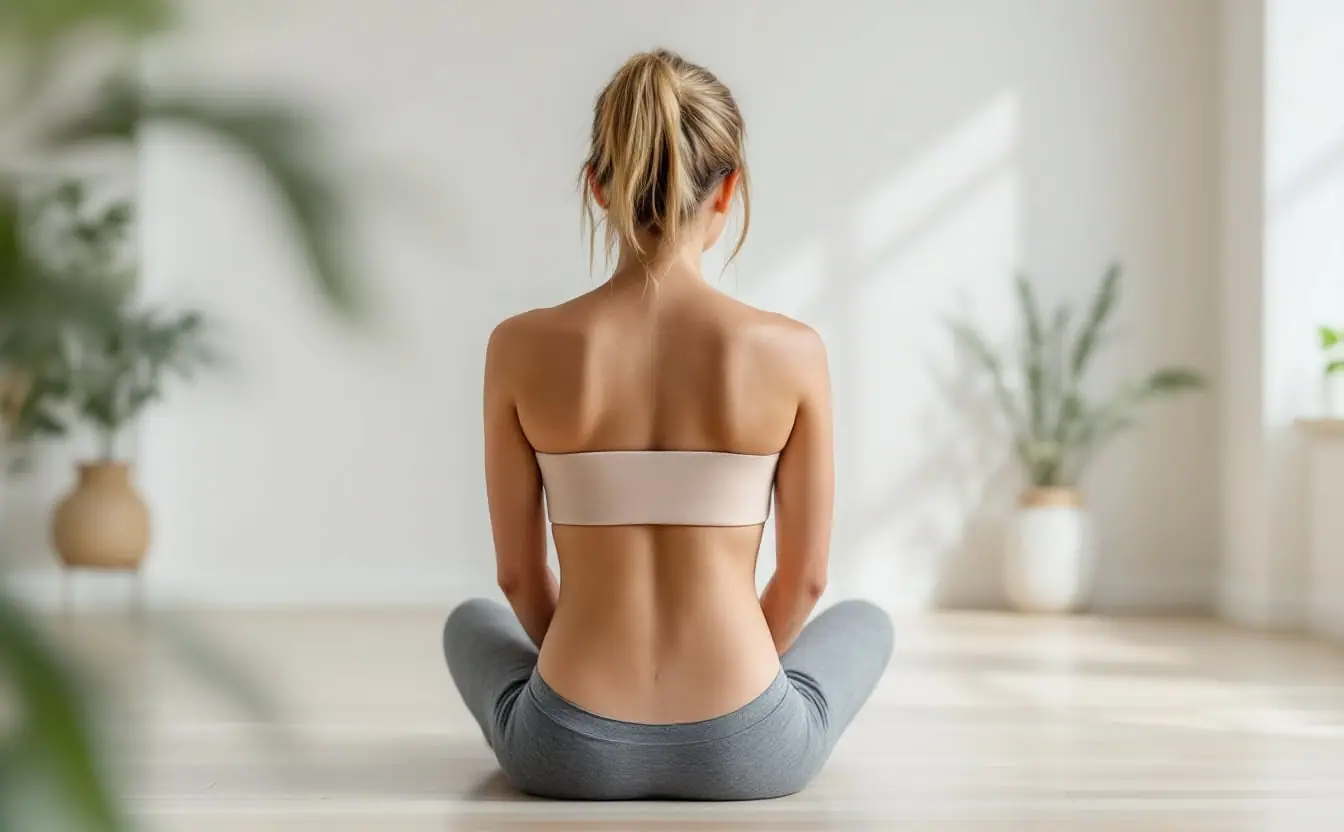
With your hands instead of a band, place them on the sides of your lower ribs, fingers pointing forward and thumbs towards your back. Feel your hands move apart as you breathe in and come back together as you breathe out. To feel the back of the ribs, try a few breaths in the rest position, kneeling with your hips back towards your heels and your forehead on your hands or a cushion. The back of the ribcage is easy to notice there.
The common mistakes are predictable. Shoulders lift. The stomach grips so hard that nothing can move. The ribs flare forward at the front on the inhale, arching the upper back. Or the breaths get bigger and faster until you feel light-headed. If that happens, stop and breathe normally; you were overdoing it, and smaller, slower breaths are fine.
Breath patterns for common exercises
Schools of Pilates differ on breath patterns, and the same exercise is cued with opposite breaths in different studios. The table shows one common way of doing it. If your teacher cues something else in class, follow your teacher.
| Exercise | One common pattern | What the breath helps with |
|---|---|---|
| The Hundred | Breathe in for five arm pumps, out for five; ten rounds make a hundred | Rhythm and stamina while the trunk stays lifted |
| Roll Up | In to reach the arms up and start, out to roll up and stretch forward; in to begin rolling back, out to lower | Smooth movement through the spine |
| Single Leg Stretch | In for one or two leg changes, out for one or two | A steady pace without breath-holding |
| Spine Stretch Forward | In to sit tall, out to round forward, in to restack the spine | The long exhale deepens the forward curve |
| Swan (preparation) | In to lift the chest, out to lower | The ribs open as the spine extends |
| Saw | In to twist, out to reach past the little toe | The exhale empties the lungs as you wring out the trunk |
| Pelvic Curl | Out to curl up, in at the top, out to roll down | The spine moves on the exhale |
| Footwork on the reformer | Steady rhythm: many teachers cue in to press out and out to return, others the reverse | Rhythm matters more than the rule |
You will notice a loose logic: exhaling often accompanies flexion, the hardest part of a movement, or the moment you need most support. Inhaling often accompanies extension and opening. It is a tendency, not a law.
When not to fuss about breath
For beginners, breath patterns can be one instruction too many. If counting breaths makes you lose track of the exercise, let the pattern go for a few weeks. The one rule that matters from day one is this: do not hold your breath while you are working hard. Holding the breath under strain pushes up blood pressure, which matters especially for anyone with high blood pressure or a heart condition. Keep breathing, at whatever rhythm comes naturally.
Fast or flowing exercises do not need a breath for every movement. Neither do stretches you hold, where slow, easy breathing is enough. And if paying close attention to your breathing makes you anxious rather than calm, which happens to some people, put your attention on the movement and let the breath look after itself.
If you have asthma, COPD or another lung condition, are recovering from chest or abdominal surgery, or are pregnant, follow the advice of your doctor, physiotherapist or respiratory team about breathing during exercise, and tell your Pilates teacher. Breathlessness that is new, unexplained or getting worse, or any chest pain, needs a doctor rather than a breathing drill.
The easiest place to practise is somewhere dull. Keep a band by the kettle, wrap it round your ribs while the water boils, and take six slow breaths into it. By the time the kettle clicks off you have done your practice for the day.