Balance after fifty: why it slips and how to train it at home
You notice it in small ways. Pulling on a sock while standing now needs a hand on the wardrobe door. A kerb you misjudged sends a jolt through you that lasts longer than it used to. Turning quickly on the stairs to answer the door feels, for half a second, like a gamble.
None of this means something is wrong. Balance is a skill as much as a capacity, and like any skill it fades when it goes unpractised and comes back when you work at it. Below: why it slips from middle age, three simple self-tests, a plan you can do at the kitchen worktop, and the signs that mean you should see a doctor first.
Why balance changes
Staying upright is a team effort. Your brain blends three streams of information: what your eyes see, what the balance organs in your inner ear report about the movement of your head, and what sensors in your feet, ankles and joints say about where your body is in space (proprioception). Then it has to act on all of that quickly, through muscles strong enough to catch a wobble.
Every part of that system changes with age. Eyes need more light and take longer to adjust between bright and dim rooms. The sensors in the inner ear become less sensitive. Feeling in the soles of the feet can dull, particularly with conditions such as diabetes. Muscle strength declines gradually from middle age if we do nothing about it, and power, the ability to produce force quickly, falls faster than strength does. Power is what gets your foot out in time when you trip. Reaction time slows a little too.
Then there is everything else. Some medicines, including some for blood pressure, sleep, mood and pain, can cause dizziness or drowsiness. A drop in blood pressure when you stand up quickly can leave you light-headed. And long, comfortable stretches of sitting remove the daily practice that kept balance ticking over without your noticing. Some of what people put down to age is really lack of use, and that is the part you can change most.
Why it is worth the effort
The NHS says that around one in three adults over 65 who live at home will have at least one fall a year. Most falls do not cause serious injury, but they can knock confidence badly, and fear of falling leads many people to move less, which weakens balance further. It is a slow spiral, and it is easier to stay off it than to climb back up.
The encouraging news is that this is one of the better-studied corners of exercise science. Reviews of the trials have found that exercise programmes built around balance and functional movements, such as standing up, stepping and turning, reduce the rate of falls in older people living at home. The UK Chief Medical Officers' guidelines ask adults to do muscle-strengthening activity on at least two days a week, and suggest that older adults include balance and flexibility work as well. Fifty is a good age to start, while the work still feels like training rather than prevention.
Trunk strength matters as much as leg strength; core strength for a long life explains what the deep trunk muscles do when you shift your weight.
Three simple self-tests
Do these next to a kitchen worktop or a heavy chair that will not slide, in bare feet or flat shoes, with a clear floor around you. If you feel unsteady in everyday life, ask someone to stand beside you. Skip anything that makes you dizzy.
| Test | How to do it | What to note |
|---|---|---|
| Single-leg stand | Fingertips on the worktop, lift one foot just clear of the floor, then let go. Stop when the foot touches down or your hand returns, or at 30 seconds | Seconds on each leg |
| Tandem stand | Place one foot directly in front of the other, heel touching toes, as if on a tightrope. Let go of the worktop if you can | Seconds, up to 30, with each foot in front |
| 30-second chair stand | Sit on a firm chair without arms, its back against a wall, arms crossed over your chest. Stand up fully and sit down as many times as you can in 30 seconds | Number of full stands |
These are general indicators, not a diagnosis. Their real value is as a baseline. Write the numbers down with the date, then repeat the tests in six to eight weeks under the same conditions.
The single-leg stand gets a lot of attention, and with some reason. Observational research has linked being unable to stand on one leg for about ten seconds in later middle age with poorer health outcomes over the following years. That is an association, not proof that wobbling causes anything, and it is a reason to practise, not to panic. If you cannot manage ten seconds on either leg, make balance a priority and mention it at your next GP appointment. There are more functional checks in fitness is not how you look.
An eight-week practice plan
Balance improves with practice that is specific, frequent and slightly challenging. Aim for three sessions of about fifteen minutes a week, plus short top-ups on other days. Keep a hand near the worktop throughout, especially at first.
The routine
- Weight shifts, 1 minute. Stand tall with feet hip-width apart. Shift your weight slowly onto one foot, then the other, then forwards towards your toes and back towards your heels, without bending at the hips.
- Heel raises, 2 sets of 10. Rise onto the balls of your feet for a count of two, lower for a count of three. Strong calves and ankles make most of the small corrections that keep you upright.
- Sit to stand, 2 sets of 8 to 10. From a firm chair, feet slightly behind your knees, lean forward and stand up without using your hands if you can. Sit down slowly, taking three counts to land.
- Tandem stand, 3 holds each way. As in the test, up to 30 seconds, swapping which foot is in front.
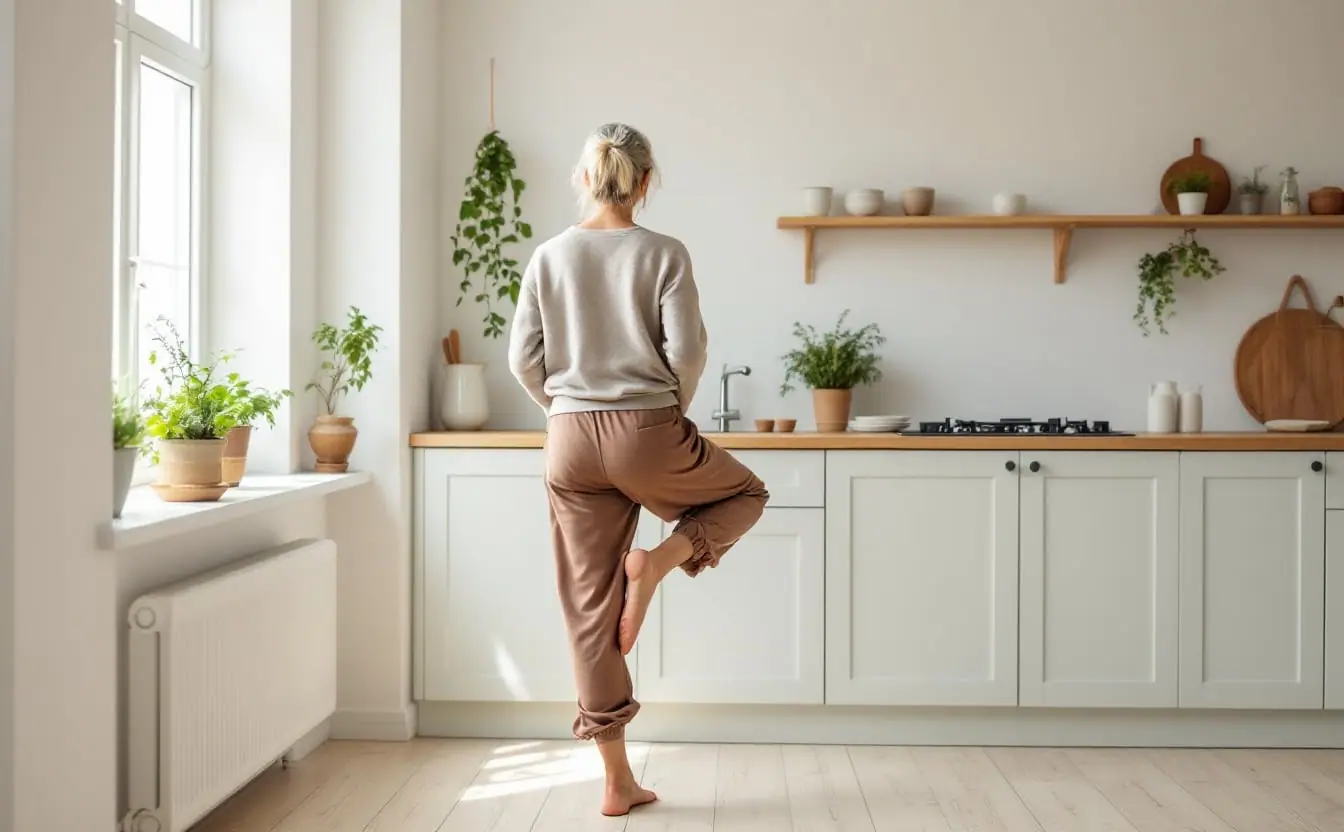
- Single-leg stand, 3 holds on each leg. Start with fingertips on the worktop and lift them away as you settle. Look at a fixed point at eye level.
- Side leg lifts, 8 to 10 each side. Standing tall, lift one leg a short way out to the side without leaning the other way, then lower with control. This works the muscles on the outside of the hip (gluteus medius) that keep your pelvis level when you walk.
- Heel-to-toe walk, 2 lengths. Walk along the worktop or a hallway wall, placing each heel directly in front of the other toes, fingertips trailing the surface.
- Step-ups, 8 on each leg. On the bottom stair, holding the banister, step up with one foot, bring the other to meet it, step down. Push through the front foot rather than springing off the back one.
Making it harder
Progress one thing at a time, and only when the current version feels steady on three sessions in a row.
| Weeks | Focus | What changes |
|---|---|---|
| 1 to 2 | Learn the moves | Both hands resting on the worktop for stands; one set of each exercise |
| 3 to 4 | Less support | Fingertips only; add the second set |
| 5 to 6 | Moving the head | Hands hovering above the worktop; turn your head slowly side to side during holds |
| 7 to 8 | Adding a task | Stand on a folded bath towel, or count backwards in threes during holds; retest at the end of week 8 |
Eyes-closed work is a big step up because it takes vision out of the system. Leave it until the end of the plan, and only try it with both hands resting on the worktop.
For the top-ups, attach a balance habit to something you already do. Stand on one leg while you brush your teeth, swapping halfway. Do heel raises while the kettle boils. Walk heel to toe down the hall on the way to bed.
Where Pilates fits
Pilates complements this well. Standing work, footwork on the reformer and mat exercises that build trunk control all feed into steadier balance, and a good class makes you practise moving slowly and precisely, which is exactly what balance needs. If you have started on our 20-minute classical mat sequence, keep it going and add the standing routine above on alternate days. Tai chi is another well-studied option for balance in later life, and many community centres run classes. Our piece on what regular Pilates changes first covers what to expect in the early months.
Make your home easier to move around
Training reduces the chance of a fall. Your surroundings decide how much a small slip costs you. A quick walk round the house with this list takes ten minutes:
- Light. Bright bulbs on the stairs, switches at the top and bottom, and a plug-in night light between bedroom and bathroom.
- Floors. Loose rugs secured with grippers or put away; trailing cables tidied; spills wiped up straight away.
- Stairs. A firm handrail, ideally on both sides, and nothing left sitting on the steps waiting to go up.
- Bathroom. A non-slip mat in the bath or shower, and grab rails if getting in and out feels awkward.
- Feet. Shoes or slippers that fit, with a back and a grippy sole. Socks on wooden floors and stairs are a hazard.
- Eyes. Regular sight tests (free on the NHS in England from age 60), and care with varifocals on stairs, where the lower part of the lens can blur the steps.
- Getting up. Sit on the edge of the bed for a few breaths before standing, especially at night.
- Pets. Know where the cat likes to sleep.
When to see a doctor or physiotherapist
Speak to your GP before starting, and sooner rather than later, if any of these apply:
- Dizziness, a spinning sensation (vertigo) or light-headedness, especially when you stand up or turn your head.
- Any fall, even one that did not hurt you, or a run of near misses.
- Unsteadiness that came on quickly or is steadily getting worse.
- Numbness, tingling or burning in your feet.
- New unsteadiness after starting or changing a medicine. Ask for a medication review.
A GP can check your blood pressure lying and standing, look at your medicines and, where it would help, refer you to a physiotherapist or a local falls prevention service, many of which run supervised strength and balance classes. Sudden loss of balance with weakness on one side, a drooping face or slurred speech is different: that is an emergency, so call 999.
Start tonight. Brush your teeth standing on your left leg, one hand resting near the basin, and swap to the right when you move on to the bottom teeth.