Mat or reformer: where a Pilates beginner should start

Most people make their first Pilates decision by price or postcode. The class nearest the office is a mat class in a church hall, or the studio that opened on the high street has a row of reformers and a glossy intro offer, and that settles it. Neither is a bad way to start. But the two formats teach the method from different directions, and knowing the difference can save you a few months of wondering why it is not quite clicking.
Both are Pilates. The exercises share names, principles and many of the same shapes. The mat work was what Joseph Pilates published for people to do at home, and the apparatus, with the reformer as its best-known piece, grew up alongside it in his New York studio. Classical teachers would say you need both eventually. The question here is only where to begin.
What the mat teaches
On the mat you work with your own body weight and nothing else. There is no spring to help you up in a Roll Up and no carriage to steady you in a Side Kick. That makes the mat honest. If your abdominals cannot yet curl you off the floor with control, you find out quickly, and you learn to use your breath, your trunk and the floor to do it.
It also makes some exercises harder than their reformer versions. The Roll Up, the Teaser and anything that asks you to lift your own legs against gravity can feel out of reach for a while. A good teacher will give you preparations and modifications: bent knees, a hand behind the thigh, a smaller range.
The mat's great advantage is that it travels. Everything you learn in class can be done in a spare half hour at home with nothing more than a firm, slightly thicker mat than the ones sold for yoga. Once you know the basic order, a short routine like the twenty-minute classical mat sequence can carry you between classes.
What the reformer teaches
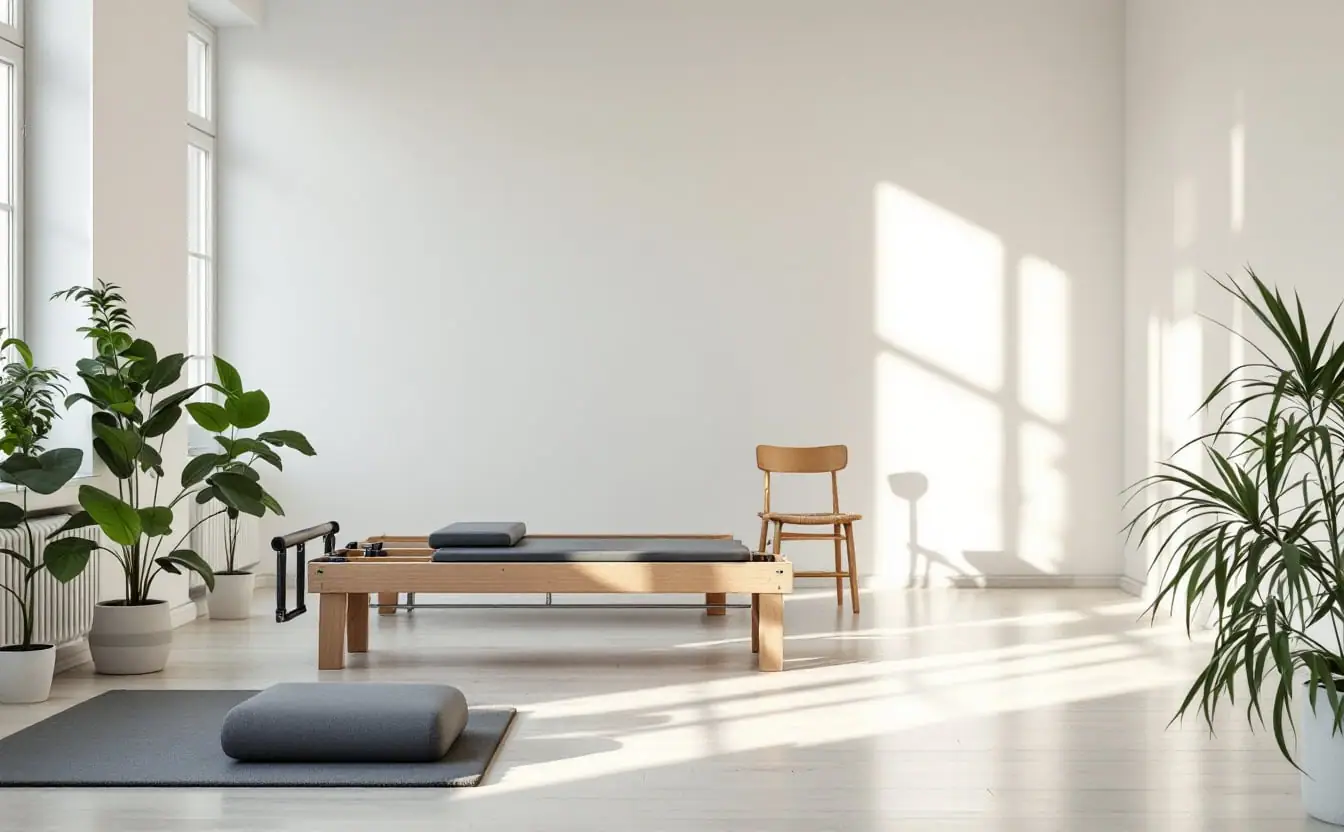
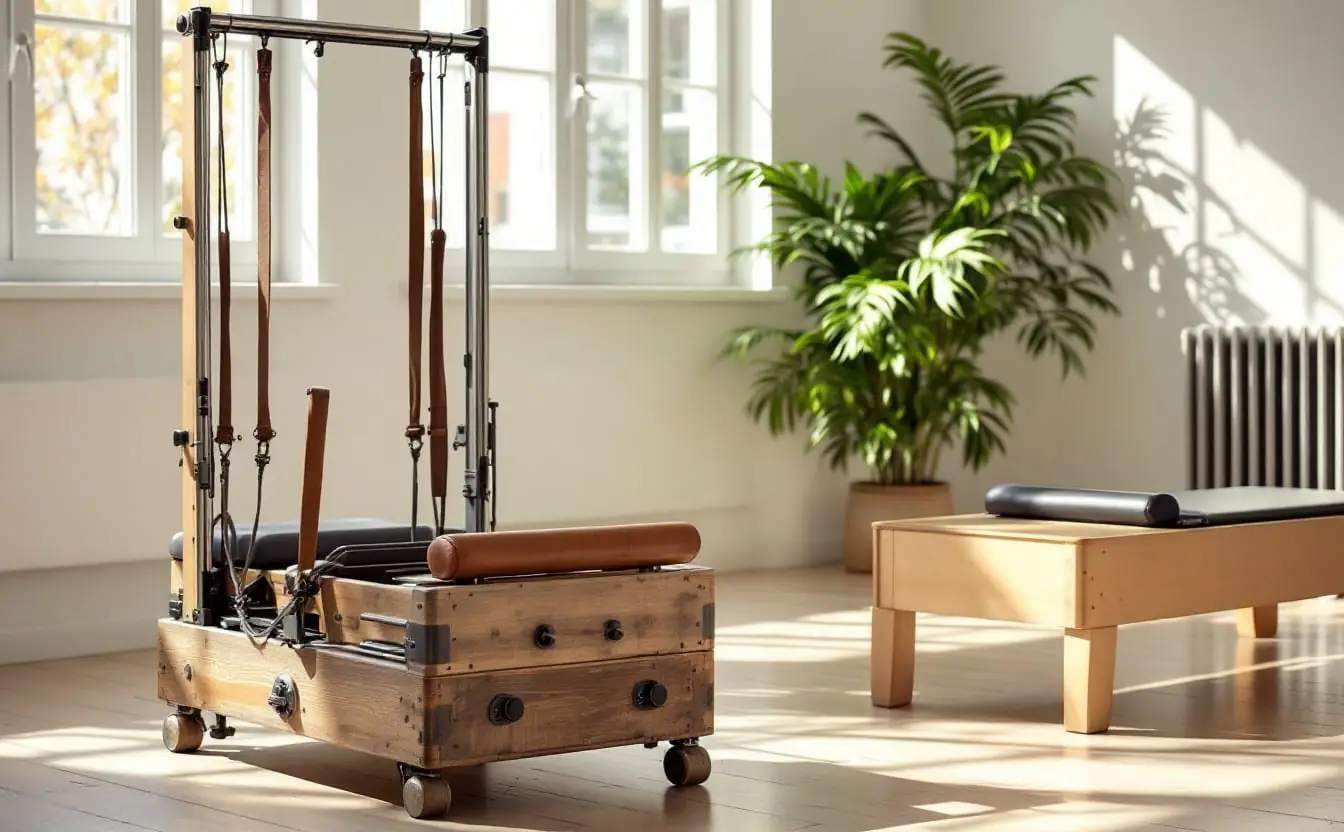
The reformer is a sliding carriage on a frame, attached to springs at one end, with a footbar to push against and straps for the hands or feet. The springs can resist you, as in Footwork, where you press the carriage away and control its return. They can also assist you, taking some of your weight in exercises that would be too hard on the floor.
The machine gives constant feedback. Lose control and the carriage moves when it should not, or comes home with a bang. Push unevenly and you feel it. For many beginners this makes alignment easier to learn: lying on your back for Footwork, with the spine supported and the legs working against springs, is a clear place to discover what a level pelvis and a long neck feel like.
The downsides are practical. Reformer classes cost more. There is a learning curve with the machine itself: changing springs, getting on and off safely, putting feet into straps. And in a busy class it is possible to let the springs do the work and leave without having learned very much.
Class formats you will meet
- Group mat classes in gyms, leisure centres and community halls, often 10 to 25 people, usually 45 to 60 minutes.
- Studio mat classes, generally smaller, sometimes with small props such as a ring, a soft ball or a band.
- Group reformer classes, typically 4 to 12 machines, though some larger studios run more.
- Private sessions, on the mat or on the full range of apparatus, and duets for two people sharing a teacher.
- Beginner courses, a block of four to six weekly sessions with the same group, often the gentlest way in.
- Online mat classes, cheap or free, useful once you know the basics, but with nobody to correct you.
Class size matters more on the reformer than on the mat, because the teacher has to watch springs and straps as well as bodies. If you are weighing up a large studio, the piece on whether a ten-person reformer class is safe sets out what one teacher can and cannot see.
Side by side
Prices below are a rough guide for the UK and vary a great deal by city and studio. London is usually at the top of each range or above it.
| Mat | Reformer | |
|---|---|---|
| Rough price per group class | £8 to £18 | £18 to £40 |
| Typical group size | 10 to 25 | 4 to 12 |
| Main resistance | Your own body weight | Springs, which resist or assist |
| Feedback | The floor and the teacher | The carriage, the springs and the teacher |
| Hardest part for beginners | Lifting your own trunk and legs | Learning the machine and its safety |
| Practising at home | Easy, needs only a mat | Needs a reformer, from several hundred to several thousand pounds |
| Good for learning | Control, breath, the classical order | Alignment, leg work, working under load |
| Risk in a big class | Struggling quietly at the back | Letting the springs do the work |
Private sessions sit outside the table. As a rough guide, a one-to-one hour costs somewhere between the price of three and six group mat classes, depending on where you live and how experienced the teacher is. For how studios arrive at these numbers, see the piece on pricing Pilates classes.
Who should start where
Start on the mat if
- You want to practise at home as well as in class.
- Your budget is tight. Two mat classes a week can cost less than one reformer class.
- You already exercise and want to learn control and the order of the classical work.
- You like a larger, more sociable group.
Start on the reformer if
- Lifting your head and shoulders off the floor is very hard at first and you would like the springs to help.
- You want plenty of leg work and a sense of working against load.
- You learn best from feedback you can feel rather than instructions you hear.
- You find a smaller class easier to settle into.
Start with a few private sessions if
- You have a back problem, a recent injury, a joint replacement or osteoporosis, or you are pregnant or postnatal. Check with your GP or physiotherapist first, then look for a qualified teacher who will see you in person and adapt the work.
- You are nervous about joining a group and would rather learn the basics without an audience.
- You want to try both mat and apparatus before committing to either.
Three or four privates before joining a group can make every later class more useful, because you arrive knowing the vocabulary and what your own body tends to do.
Questions beginners ask
Can I go straight into a reformer class with no experience?
Many studios ask beginners to take an introductory session or a beginners' class first, and that is a good sign. Be more cautious about a studio that puts first-timers into a fast mixed-level class without asking anything about them.
Is one better than the other for getting stronger?
Neither is better in general. Both build strength and control when taught well, and the reformer can add more load for the legs. What makes the difference is regular practice, ideally two or three times a week, and a teacher who progresses you sensibly.
Will I need special kit?
For mat classes, comfortable clothes that let the teacher see your knees and hips. Studios usually provide mats. For reformer classes, many studios ask for grip socks, which stop your feet sliding on the footbar and platform. Check before you go.
Does the order I learn in matter?
Classical teachers generally teach the mat first because it is the foundation, and the apparatus as a way to deepen it. Contemporary studios often start beginners on the reformer. Either route works if the teaching is good. What matters more is the teacher, and the checklist in the guide to finding a good Pilates studio is a sound place to start.
A first month that works for most people
- Weeks one and two: two beginner classes a week in whichever format is easiest to reach, or a short private block.
- Week three: book one class in the other format, even if you think you know which you prefer.
- Week four: go back to the format that suited you and keep a home mat routine of 10 to 15 minutes on two other days.
Whatever you choose, book four classes rather than one. The first is mostly about learning where to put your feet and what the teacher means by the powerhouse. By the fourth you will know which you prefer, the springs or the floor, which is more than any comparison table can tell you.