Pilates socks: how to choose grip socks for mat and reformer
Some links in this story go to Amazon. As an Amazon Associate I earn from qualifying purchases.
Pilates socks are grip socks: ordinary-looking socks with silicone dots or patterns on the sole that stop your feet sliding on a mat, a reformer footbar or a polished studio floor. Most reformer studios ask you to wear them, for hygiene and for grip on a carriage that moves under you. Many mat classes recommend them, and at home on your own mat bare feet are usually fine.
That is the short answer. The longer one is about which pair. Grip socks come with full toes, open toes, separate toes, straps across the top and cuffs from invisible to mid-calf, and the differences matter more than they look on the shelf. A sock that wrinkles under your heel turns its grip into a slip. One that rolls off in Footwork is a distraction for the whole class. This guide covers why studios want them, when you can skip them, and how to pick, size and wash a pair so it lasts.
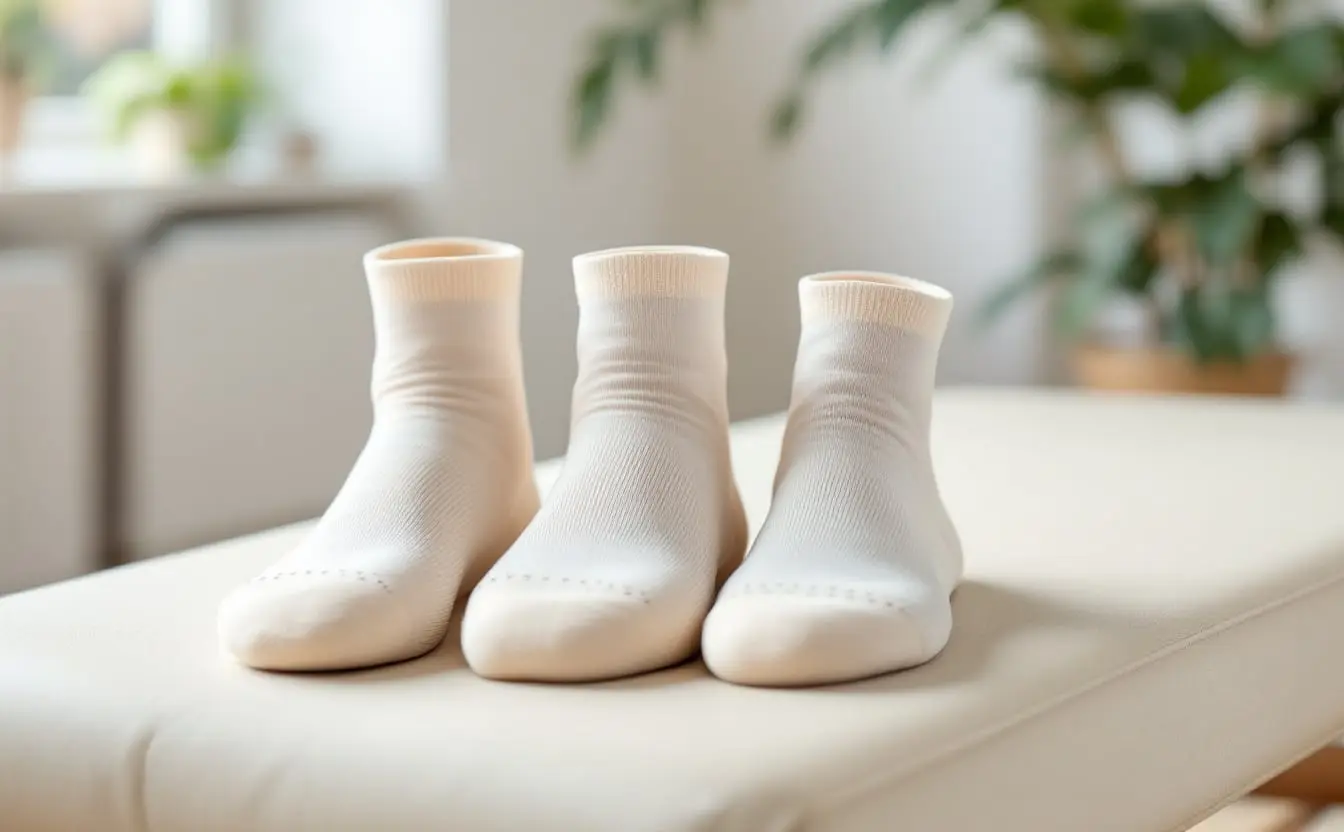
Three pairs of Pilates grip socks, side by side
These three cover the main shapes: strappy, plain unisex and a men's cut. None of them is a toe sock, which is a style some people love and others cannot stand; more on that below.
| Pick | Best for | Key facts |
|---|---|---|
| Ozaiic grip socks with ballet-style straps | Mat and reformer classes if you like a snug, strappy sock | Combed cotton with silicone grip on the sole; criss-cross straps over the instep; women's sizes |
| unenow unisex grip socks | A plain pair with no straps or frills | Ankle height; cotton, nylon and spandex mix; grip dots across the sole; unisex sizing, sold in multi-packs |
| Muezna men's grip socks | Larger feet and men's sizes | Cotton with silicone grip on the sole; men's sizing; crew-style cuff |
These picks come from the makers' specifications, published reviews and how each style suits a Pilates class. We have not tested them ourselves, so use the table to narrow the field and the sections below to decide.
Do you need grip socks for Pilates?
For reformer classes, usually yes. Many studios that run group reformer classes list grip socks as a requirement, and many sell them at the front desk for anyone who forgets. There are two reasons, and both are good ones.
The first is hygiene. A reformer has a footbar, a platform, foot straps and shoulder rests that a dozen or more pairs of feet touch in a day. Studios wipe the machines between classes, but a sock adds a layer between your skin and the last person's. The second is grip. In Footwork you press against a padded bar while the carriage slides away and comes back under spring tension. In Elephant your feet stay on the carriage while it moves, and in Knee Stretches you kneel on it with your feet against the shoulder rests. A foot that slips in any of those positions is not just annoying; it can send the carriage home with a bang. Grip socks keep your feet where you put them.
For mat classes the rules vary. Some studios ask for socks on shared mats; plenty of teachers prefer bare feet. If you are still deciding between the two formats, the guide to starting on the mat or the reformer sets out what each class expects of a beginner, kit included. Whichever you choose, check the studio's page or ask at the desk before your first class.
Can you do Pilates barefoot?
Yes, and for mat work at home it is often the best option. Bare feet let you spread the toes and feel the floor, which helps in standing work and in anything where the feet press or reach, like the Hundred or Single Leg Circles. Many teachers work barefoot for exactly that reason.
The problems are slipping and sharing. Feet sweat, and a damp foot slides on a vinyl mat or a varnished floor, especially in standing balance work. In a studio, the equipment is shared, so bare feet are often not allowed on the reformer at all. And ordinary socks are the worst of both worlds: they cover the foot and add almost no grip, so you slide more than you would barefoot. If you train at home on a wooden floor in winter and want warm feet, a grip sock is the answer. If your feet stay dry and your mat stays put, go barefoot.
Toe socks, full-toe or strappy
The style is mostly about comfort and what you like the look of. Grip matters more, and it depends on the sole.
Toe socks
Toe socks come in two kinds: five-toe socks with a separate pocket for each toe, and open-toe socks that stop at the base of the toes and leave them bare. Fans like being able to spread and grip with the toes, and open-toe versions keep that barefoot feel on the footbar. The catch is fit. Toe pockets that do not match your toe lengths feel odd, and some people never get used to fabric between the toes.
Full-toe socks
These look like an ordinary ankle sock with a printed or dotted sole. They are the easiest to buy, the warmest on a cold studio floor and the simplest to wear under trainers on the way to class. Plain unisex packs like the unenow socks fall here, and so do most men's pairs.
Strappy socks
Strappy, ballet-style socks are cut low over the top of the foot with a pair of elastic straps crossing the instep. The straps hold the sock in place, so it does not twist when you change position, and many people simply like the look. Strappy grip socks with a cotton body suit anyone who finds plain socks slide round their heel. They cover less of the foot, which is pleasant in a warm room and less so in a draughty one.
Cuff height is the other choice. No-show socks can slip off the heel when you press through it in Footwork; ankle socks are the safe middle; crew cuffs, like the Muezna pair, stay put and keep your ankles warm in winter.
What to look for in the sole and the fabric
Grip should cover the ball of the foot and the heel, because those are the parts that press the footbar and take your weight standing. Small, dense silicone dots across the whole sole are the usual pattern and work well. Some socks also add grip under the toes, which helps in open-toe and toe-sock designs.
Cotton feels soft, breathes and takes up sweat; combed cotton is smoother and pills less. A blend with nylon and spandex hugs the foot more closely and dries faster after washing. A good pair is usually mostly cotton with some stretch in it, and the stretch is what stops it wrinkling under the arch.
Sizing grip socks
A grip sock should be snug. Any slack fabric twists in a class, and once it twists the grip dots end up on the side of your foot instead of under it.
- Check the shoe-size range on the label rather than relying on small, medium or large, which vary from brand to brand.
- If you fall between two sizes, the smaller one usually grips better, unless the cuff then digs in.
- Many grip socks are cut for women's sizes. If you have larger feet, look for a pair sized for men; men's grip socks with a crew cuff are made for exactly that.
- Strappy styles need a close fit over the instep. If the straps gape, the sock is too big.
Washing them so the grip lasts
Silicone grip wears faster with heat. The dots last longer if you turn the socks inside out, wash them on a cool cycle and let them air-dry rather than putting them in a tumble dryer. Skip fabric softener, which can leave a film over the grip. Wash them after every class, as you would any other sock.
You will know a pair is finished when the dots under the ball of the foot have worn smooth or started to peel. At that point they are ordinary socks again, which means slippery ones, so retire them to the drawer for lounging. For two classes a week, three pairs is a comfortable number: one on your feet, one in the wash, one in the bag.
Grip socks also earn their place on the road, where hotel floors are often tiled or polished. The Pilates travel kit lists them alongside a band and a small ball, and they weigh almost nothing.
Questions readers ask
What are the best Pilates socks for reformer classes?
The best pair is the one that stays put on your foot: snug, with grip on both the ball of the foot and the heel, and a cuff that does not slide down. Strappy, full-toe or toe socks all work on a reformer. Choose the style you will happily wear twice a week.
Can I wear yoga socks for Pilates?
Yes. Yoga socks and Pilates socks are usually the same product under a different label. What matters is the grip pattern and the fit, not the name on the packet.
Do men wear grip socks for Pilates?
Yes, and studios ask everyone for them, not only women. The main difficulty is size, since many packs stop at a women's shoe size. Look for a pair cut for men's sizes rather than squeezing into a unisex one that stretches thin over the heel.
Can I wear grip socks for barre or yoga?
For barre, yes; many barre studios ask for them too. For yoga, many people prefer bare feet on a sticky mat, but grip socks are fine if your feet slide or get cold.
Should I wear grip socks at home?
Only if you need them. On a good mat with dry feet, bare feet give you more feel. On a polished wooden floor, in a cold room or in standing balance work, a grip sock gives you a steadier base. If you are looking for a studio rather than practising at home, the guide to finding a good Pilates studio is a sensible place to start, and the first thing to put in your class bag is a clean pair of socks.