A Pilates travel kit and a 15-minute hotel-room session
Every summer the same thing happens. The routine that held all spring, the Tuesday class and the Saturday mat session at home, dissolves somewhere between the airport and the second evening of a holiday. By the time you are home again your hamstrings have forgotten everything and the first class back feels like week one.
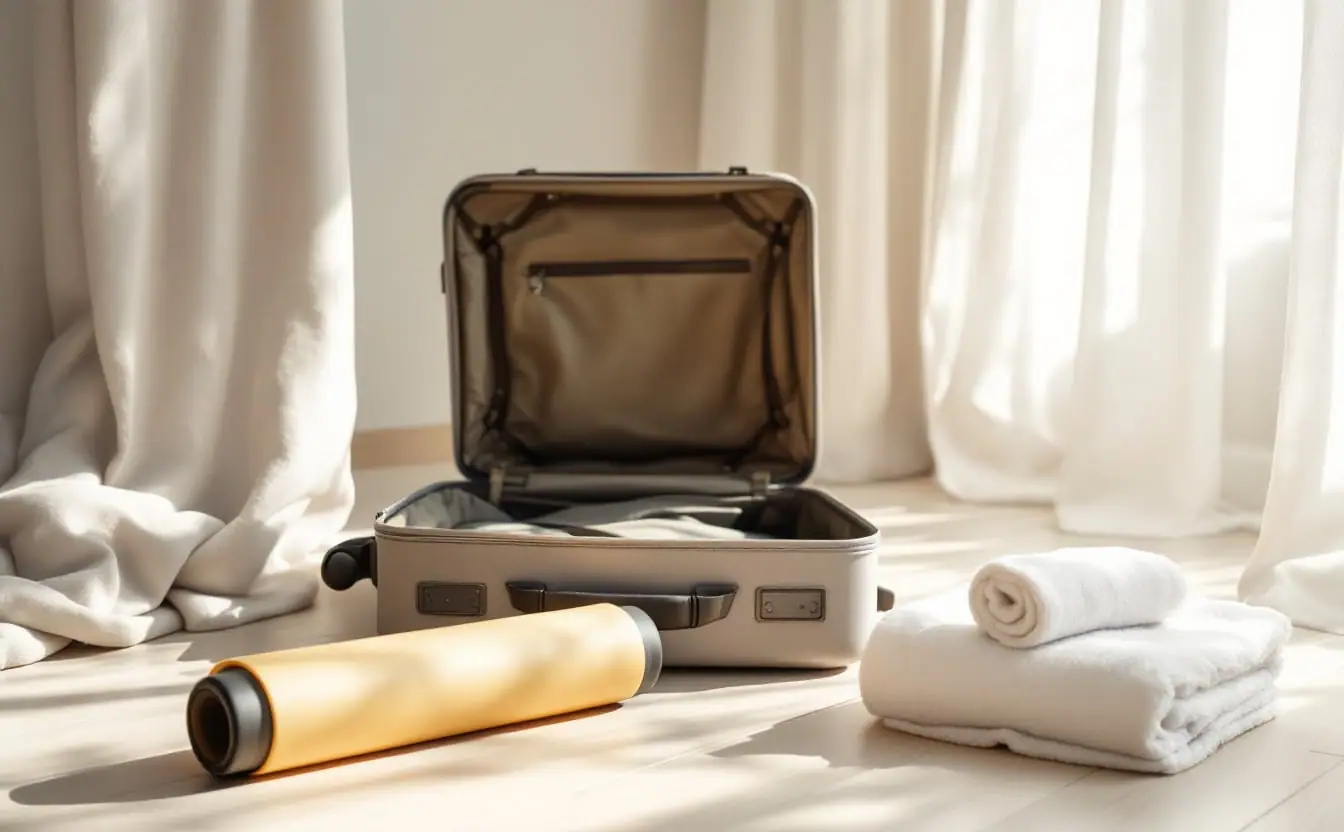
It does not have to go that way, and it does not take much. The mat work Joseph Pilates published was meant to be done on a floor at home, without machines, and a hotel room has a floor. Pack a few light things, learn one short sequence well enough to do it without a screen, and you can keep the thread going for a fortnight without turning your holiday into a training camp.
What to pack
Everything below fits in a shoe or a side pocket. Prices are rough guides for the kind of thing you will find in a sports shop or online.
| Item | Weight | What it does on the road | Rough cost | If you forget it |
|---|---|---|---|---|
| Long flat resistance band, about 2 m | under 100 g | Footwork lying down, arm work, rib breathing, hamstring stretch | £5 to £15 | A dressing-gown cord or scarf, for stretching only |
| Mini loop band | about 20 g | Side-lying leg work, bridges, standing hip work | £3 to £8 | Skip it, slow the movement down instead |
| Small soft ball, the kind you inflate with a straw | about 100 g, packs flat | Between the knees in bridges, behind the back for roll downs | £5 to £10 | A rolled hand towel |
| Grip socks | a few grams | Stop your feet sliding on tiles or polished wood | £5 to £12 | Bare feet |
| Travel mat | 1 to 2 kg | Cushioning on hard floors | £25 to £60 | Two bath towels, one folded lengthways on top of the other |
Most people can leave the travel mat at home. Two hotel towels on a carpeted floor are fine for a short session, and on tiles you can fold them double under your spine. Check the band for nicks or sticky patches before you pack it, since rubber that has spent a year in a hot car can split, and hold both ends in your hands rather than tying it to a door handle or bed leg. A band that slips off furniture snaps back fast.
Finding space
You need a strip of floor about the length of your body plus your arms overhead, and slightly wider than your shoulders. In most rooms that is between the bed and the wall, or in front of the wardrobe. Open the curtains if you can, and the window too, because a stale room makes a short session feel long.
The bed is too soft for most exercises, but it is handy for one thing: sitting on the edge for the breathing and arm work if your back does not like the floor that day. A desk or a sturdy chair back gives you something to hold for standing balance.
The 15-minute hotel-room session
This is a beginner-friendly order with a few band additions. If you have a back problem, are pregnant, or have been told to avoid rounding the spine (for example because of osteoporosis), skip the curling exercises and check with someone who knows your history before you travel. Move slowly, breathe throughout, and stop anything that pinches.
- Rib breathing with the band (1 minute). Sit tall or lie with knees bent. Wrap the band round your lower ribs, cross it at the front and hold the ends with light tension. Breathe in to widen your ribs into the band, breathe out to let them close. Six to eight breaths.
- Pelvic curl with the ball (1 minute). Lie on your back, knees bent, ball squeezed gently between your knees. Breathe out to curl your tailbone up, one bone at a time, until you rest on your shoulder blades. Breathe in at the top, breathe out to roll down. Six to eight times.
- The Hundred, modified (1.5 minutes). Knees bent in tabletop, or feet on the floor if your neck or back complains. Curl your head and shoulders up, arms long by your sides, and pump them in a small range: breathe in for five pumps, out for five. Work up to ten rounds. Rest your head whenever your neck takes over.
- Band footwork (2 minutes). Lying down, one knee bent with the foot on the floor, put the band round the ball of the other foot and hold an end in each hand, elbows resting on the floor. Press the leg out long on a diagonal, about 45 degrees from the floor, then bend it back in with control. Eight to ten presses with the foot flexed, then eight to ten pointed. Change legs.
- Single Leg Stretch (1 minute). Head down or curled up, one knee into the chest, the other leg reaching long and high. Switch legs in a steady rhythm, eight times each side. Keep your lower back heavy on the towel.
- Band arm work (1.5 minutes). Still on your back, knees bent, hold the band taut over your chest with your arms straight. Open the arms out to the sides, stretching the band across your chest, then return slowly. Eight times. Then take the arms overhead towards the floor behind you, only as far as your ribs stay down, and back. Eight times.
- Side-lying leg series (2.5 minutes). Lie on one side, head resting on your lower arm, legs slightly forward of your hips. With the mini band above your knees if you have it, lift and lower the top leg eight times, then do small front and back swings eight times, keeping the hips stacked. Turn over and repeat.
- Swan preparation (1 minute). Lie on your front, a folded towel under your hips if the floor is hard, hands under your shoulders. Lengthen through the crown of your head and lift your chest a few inches, using your back and not your arms. Lower with control. Five times.
- Spine Stretch Forward (1 minute). Sit up with your legs apart a little wider than your hips, knees softly bent if your hamstrings are tight. Breathe out to round forward from the top of your head, reaching your arms forward, then roll back up to tall. Five times.
- Saw (1 minute). Same seat, arms out to the sides. Twist towards one leg, breathe out and reach your opposite hand past the little toe, then return to centre. Three times each side.
- Standing roll down and balance (1.5 minutes). Stand with your back against the wall, feet a short step away. Nod your head and peel your spine off the wall, letting your arms hang, then roll back up. Three times. Finish with a hand on the desk and balance on one leg for 30 seconds, then the other.
If fifteen minutes is too much on a given morning, do numbers 1, 2, 4 and 11. That takes five minutes and keeps your hips and spine from setting like concrete after a travel day.
Staying regular without making it a chore
The trick on holiday is lowering the bar, not abandoning it. Three short sessions a week are a realistic target. Daily is lovely if it happens; it is not the measure of success.
Tie the session to something that already happens. Before breakfast works for most people, because the day has not yet filled with plans. Some prefer the half hour before dinner, after a shower, when the room is cool and everyone else is getting ready. Lay the band out on the chair the night before so the first thing you see is a reminder rather than a phone.
Walking counts. So does swimming. A week of long coastal walks and lazy lengths of the hotel pool is good for your body, and you do not need to top it up with mat work every day. Use the sequence to keep the feel of the work, the deep trunk muscles and the long spine, rather than to burn anything. On mornings when even five minutes feels like too much, the gentle tapping and rubbing of Do-in self-massage is a pleasant way to wake up in an unfamiliar bed.
And if the holiday swallows the plan whole, let it. Book your first class back before you leave, so there is a fixed point waiting when you land.
Long journeys
Hours in a car, train or plane seat are hard on the hips and lower back. The stiffness is the same kind you get from long desk days, and the ten-minute hip routine for desk days is a good thing to do on the evening you arrive. While you are travelling, small movements in the seat help more than you would expect:
- Ankle circles and foot pumps, pointing and flexing, twenty at a time every half hour or so.
- Seated pelvic rocks: tip your pelvis forward and back a few times, then sit tall again.
- Shoulder rolls and a slow turn of the head to each side.
- A few rib breaths with your hands on your lower ribs.
- Standing at the back of the plane or in the train vestibule for calf raises, when it is safe to get up.
The standard advice for long journeys is to get up and walk when you can, drink water, and go easy on alcohol, partly for comfort and partly to reduce the risk of blood clots in the legs. If you have had a clot before, are pregnant, have had surgery in the last few weeks, or have been told you are at higher risk, ask your GP or pharmacist about precautions such as compression stockings before you fly. On the road, the Highway Code recommends a break of at least 15 minutes every two hours of driving, which is also a perfectly good moment for a standing roll down by the car.
Jet lag
Crossing time zones throws your body clock out of step with the day around you, and sleep, appetite and energy follow. Light is the strongest signal you have for resetting it. Get outside in daylight at the times that match your new schedule: on arrival, eat and sleep on local time, and if you must nap, keep it short.
Movement helps in a supporting role. A brisk walk outdoors in the morning light does more for jet lag than a hard workout in a dim hotel gym, and a slow version of the session above in the evening can help you settle without winding you up. Save anything vigorous for the second or third day, when you are sleeping properly again, and keep caffeine to the morning.
One last packing tip. Roll the band round the deflated ball, stuff the bundle into a sock, and put the sock inside a shoe. It weighs almost nothing, and it is very hard to ignore when it falls out onto the floor.