Do-in, the Japanese habit of tapping yourself awake
Do-in tends to turn up in the back pages of macrobiotic cookbooks, somewhere between the miso soup and the brown rice, illustrated with line drawings of a calm person drumming on their own skull. It looks a little odd. It is also one of the most useful ten minutes you can spend before breakfast.
In short, Do-in is a self-care routine from Japan that mixes tapping, rubbing, pressing, stretching and slow breathing. You need no equipment, no mat if you would rather stand, and no teacher once you know the order. It sits in the same family as shiatsu, and it pairs well with a Pilates practice because both care about where movement starts and how the breath supports it.
Where Do-in comes from
The name is the Japanese reading of the Chinese daoyin, usually translated as guiding and pulling: guiding the breath, pulling and stretching the limbs. Daoyin is very old. One of the best-known early records is a painted silk chart found in a Han dynasty tomb at Mawangdui, in Hunan province, sealed in 168 BC. It shows several dozen figures in exercise postures, some with arms raised, some bending, some apparently imitating animals.
These practices travelled to Japan alongside Chinese medicine and Buddhism. In the twentieth century Do-in reached Europe and North America largely through the macrobiotic movement. Michio Kushi's The Book of Do-In, published in 1979, gave many Western readers their first full description of it, with exercises for every part of the body.
Shiatsu is the close cousin. In shiatsu a practitioner applies pressure to you; in Do-in you do it to yourself, using the same traditional map of points and pathways. In Leiden, for example, the Dutch teacher Lilian Kluivers teaches Do-in.
The ideas behind it
Traditional Do-in rests on the meridian system of East Asian medicine: twelve main channels, each linked to an organ, along which ki (the Chinese qi) is said to flow. Tapping and stretching along a channel is meant to keep that flow moving. The sequence usually follows the direction the channels are thought to run, which is why you tap down the inside of the arm and back up the outside.
It is fair to say plainly that meridians are a traditional framework, not structures an anatomist can find. You do not need to accept the theory to enjoy what the routine does in practice: it warms the skin, loosens the jaw and shoulders, gets you breathing more slowly and makes you notice your body before the day starts asking things of it.
Do-in also gives a great deal of attention to the hara, the area of the belly a few fingers below the navel, treated as the body's centre of gravity and calm. Pilates people will recognise the idea. It is not identical to the powerhouse, but it points to the same region, and our piece on what the core really is explains why the deep muscles there matter so much more than a visible six-pack.
A ten-minute morning Do-in
Stand with your feet hip-width apart and your knees soft, or sit on the edge of a firm chair if standing is tiring. Use loose fists or relaxed fingertips, and keep your wrists floppy. The pressure should feel like a brisk, friendly knock, never a thump.
- Shake out (1 minute). Bounce lightly through the knees and let your arms dangle and shake. Breathe out through the mouth a few times.
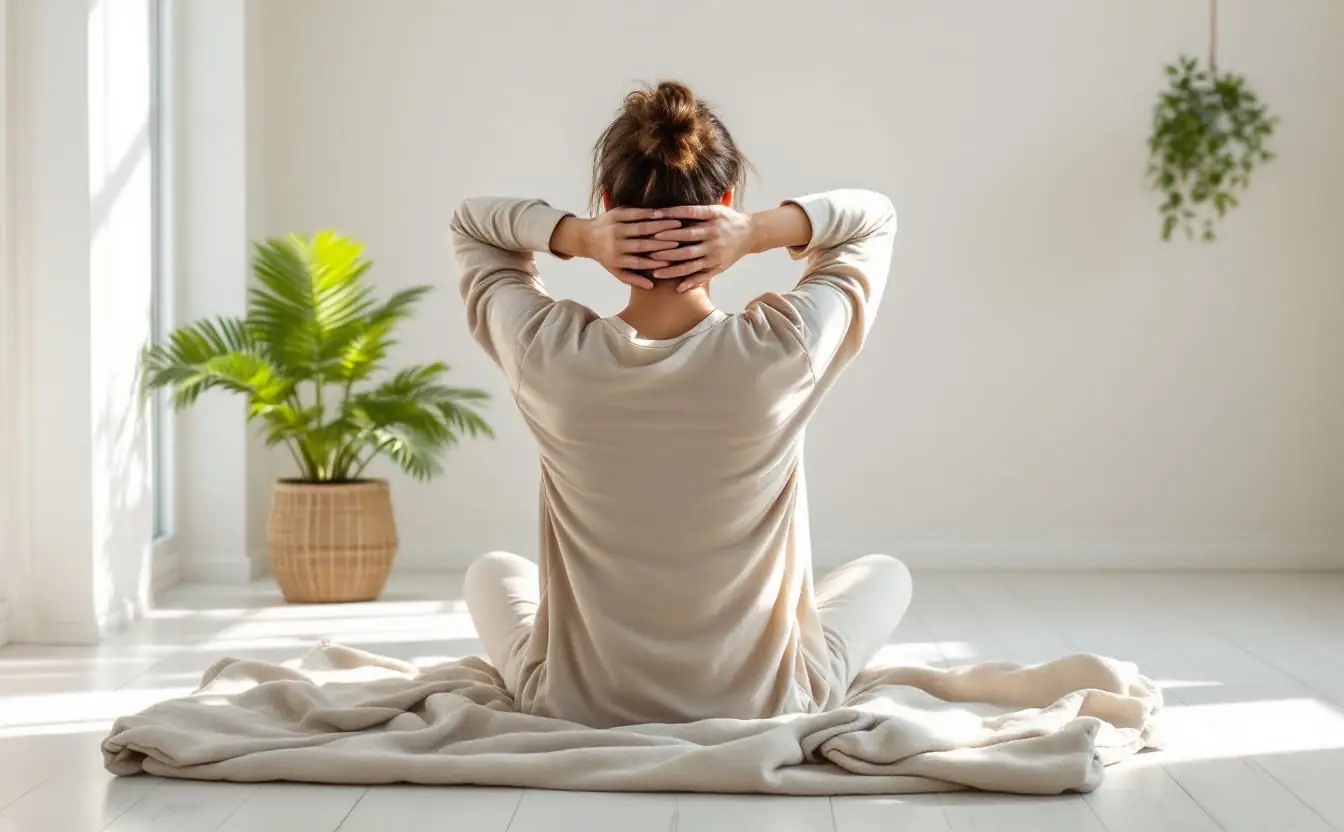
- Scalp and face (1 minute). Tap your fingertips over the scalp from the hairline to the back of the head and round the sides. Rub your palms together until they are warm and rest them over closed eyes for three breaths. Make slow circles along the eyebrows, over the cheekbones and at the hinge of the jaw, then rub each ear from the top down to the lobe.
- Arms (1 minute 30 seconds). Hold one arm out, palm up. Tap from the shoulder down the inner arm to the palm, turn the hand over and tap back up the outside to the shoulder. Three passes, then change arms.
- Chest (30 seconds). Tap gently just below each collarbone, then down the breastbone with your fingertips.
- Lower back and hips (1 minute). Reach behind you and tap from as high on the back as you can comfortably reach, down over the flat bone at the base of the spine and across the buttocks. Finish by rubbing the lower back with warm palms.
- Legs (1 minute 30 seconds). Bend your knees a little. Tap down the outside of the legs to the ankles and back up the inside, then down the back of the legs and up the inside again.
- Feet (1 minute). Sit down. Knead each sole with your thumbs, rub the arch firmly and give each toe a slow pull.
- Stretch (1 minute). Still seated, reach both arms overhead, interlace the fingers and lean to one side for three breaths, then the other. Fold forward over your legs with soft knees for three breaths.
- Hara breathing (1 minute). Sit tall, hands resting below the navel. Breathe in through the nose and let the belly swell into your hands, then breathe out for longer than you breathed in. Six to ten rounds.
- Pause (30 seconds). Sit still with your eyes closed and notice what feels warmer, looser or more awake than before.
What it can and cannot do
| It can | It cannot |
|---|---|
| Warm you up gently before exercise or work | Unblock organs or treat illness |
| Ease the feeling of tension in the jaw, neck and shoulders for a while | Replace a diagnosis when pain keeps coming back |
| Slow your breathing and settle a busy head | Cure a cold, a migraine or a bad back |
| Build a daily habit that costs nothing | Do the job of strength training |
Research on massage in general suggests it can bring short-term relief from muscle tension and soreness and a sense of calm, and slow breathing with a longer exhale is widely used to settle the nervous system. That is a modest, honest list of benefits, and plenty of reason to keep doing it. Claims that a particular tapping pattern treats a particular organ go well beyond any good evidence.
A few cautions. Skip tapping over bruises, varicose veins, broken skin, recent injuries or a sore joint. If you have osteoporosis, keep the pressure light and ask a physiotherapist which areas to leave alone. If you bruise easily because of medication, rub rather than tap. Traditional teaching advises against firm pressure on the top of the shoulders in pregnancy, and anyone pregnant should ask their midwife or a qualified teacher before starting a new self-massage routine. Pain that persists, or any new pain you cannot explain, needs a doctor rather than another round of tapping.
Fitting it around a Pilates practice
Do-in works well in three places. Before a mat session, steps one to six make a decent warm-up. After class, the foot work and hara breathing make a quiet cool-down. And at a desk, the scalp, face and arm sequence takes two minutes and does not require you to lie on the office carpet.
It also fits the history of Pilates rather neatly. Joseph Pilates grew up in a German culture of nature cures, cold water and vigorous skin care, which we looked at in Kneipp, Mensendieck, Steiner and Joseph Pilates. A man who told his readers to scrub themselves with a stiff brush would not have found self-massage strange.
One word on the food that came packaged with Do-in in the West. Macrobiotic eating leans on whole grains, vegetables, beans, sea vegetables and miso, and I like a lot of that. The stricter versions, though, can leave someone who trains short of protein and energy. If that sounds familiar, my guide to plant protein for people who train shows how to fill the gap without giving up the miso.
Try it tomorrow before the kettle goes on: bare feet on the kitchen floor, loose fists, ten minutes, and see whether you still want the second coffee.