Plant protein for people who train: how much, and where to find it
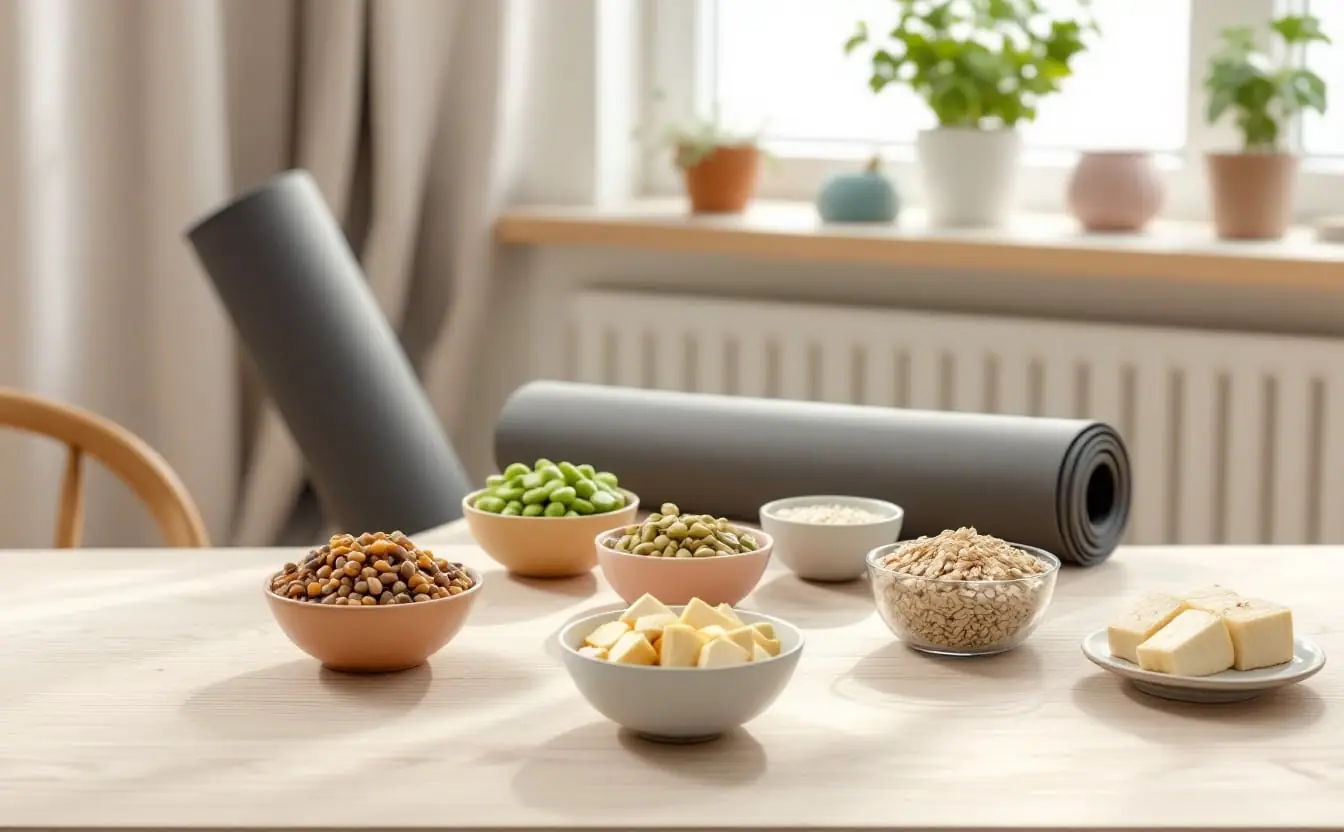
Anyone who eats mostly plants and trains a few times a week gets asked about protein. Usually by someone holding a chicken sandwich. The honest answer is that protein on a plant-based diet is rarely a question of whether it exists. It is a question of planning, and of knowing which foods actually carry their weight on the plate.
This is a practical guide: roughly how much protein active adults tend to aim for, what the business about "complete" proteins means, why leucine keeps appearing in sports nutrition writing, and which plant foods give you the most for the least effort. All the figures here are approximate. Labels vary by brand, and so do bodies.
How much people who train usually aim for
The UK reference nutrient intake for adults is 0.75 g of protein per kilogram of body weight per day. That number is set to cover the needs of nearly everyone in a population going about ordinary life. It was never meant as a target for someone doing reformer three mornings a week and lifting at the weekend.
For people who exercise regularly, sports nutrition guidance generally lands higher. A range of around 1.2 to 1.6 g per kilogram per day is often cited for regular exercisers, and a 2016 joint position statement from American and Canadian dietetic and sports medicine bodies put the range for athletes at 1.2 to 2.0 g. Treat these as general guidance rather than a prescription. Someone doing two gentle mat classes a week sits near the bottom. Someone training hard most days, trying to build muscle, or eating less to lose weight tends to sit nearer the top.
In practice, a 65 kg person at 1.2 to 1.6 g per kilogram is looking at roughly 78 to 104 g a day. Spread over three meals and a snack, that is somewhere around 20 to 35 g a sitting, which is a far easier number to hold in your head than a daily total. If your training is stepping up, say you have moved from a weekly mat class to apparatus work that builds steadily in load and range, the way a good teacher plans progression from one level to the next, it makes sense to drift up the range with it.
One caveat, said once. If you have kidney disease, or any condition where you have been told to watch your protein, talk to your GP or a registered dietitian before raising your intake. For everyone else, eating towards the upper end of these ranges from ordinary food is an unremarkable thing to do.
Complete proteins and the combining myth
Protein is built from 20 amino acids. Nine of them the body cannot make, so they have to come from food, and these are the essential amino acids. A "complete" protein contains all nine in useful proportions. Animal foods generally do. Most plant foods also contain all nine, but one or two tend to run low: grains are usually short on lysine, while beans and lentils are lower in the sulphur-containing amino acids, methionine and cysteine.
The convenient thing is that the gaps mirror each other. Grains and legumes cover for one another, which is why so many traditional dishes pair them without anyone thinking about amino acids at all. Dal and rice. Beans and tortillas. Hummus and pitta. Peanut butter on toast.
The idea that you must combine them at the same meal was popularised by Frances Moore Lappé's 1971 book Diet for a Small Planet, and Lappé herself relaxed that advice in later editions. Your body keeps a working pool of amino acids, so what matters is a varied intake across the day rather than a perfectly matched plate.
Soya is the useful exception to the rule. Tofu, tempeh, edamame and soya milk carry a good spread of all the essential amino acids in a single food, which makes them the backbone of many plant-based training diets. Quinoa and buckwheat are often described as complete too, though a portion of either carries modest protein next to a portion of lentils.
Leucine and the per-meal question
Leucine is one of the essential amino acids, and it gets attention because it acts as a signal that switches on muscle protein synthesis after you eat. Sports nutrition writing often talks about a "leucine threshold", and a figure of around 2 to 3 g per meal is commonly quoted. The research behind it is less tidy than the round number suggests, but the general direction is sound: a meal with a decent dose of quality protein does more for muscle than a scattering of small amounts.
Plant proteins generally carry a little less leucine per gram than milk or whey protein. They are also slightly less digestible in whole-food form, because fibre and other compounds get in the way. Neither point is a dealbreaker. The practical fix is undramatic: eat slightly larger portions of protein-rich foods at each meal, lean on soya and pulses, and stop building meals around things that only look high in protein.
A bowl of vegetable soup with a sprinkle of seeds is a perfectly nice lunch. It is not a recovery meal. A bowl of lentil soup with a thick slice of seeded bread gets much closer.
The plant sources that do the most work
The table below gives approximate protein for typical portions. Figures are rounded and vary between brands and recipes, so check the label on what you actually buy.
| Food | Typical portion | Protein (approx.) |
|---|---|---|
| Firm tofu | 100 g | 12 to 16 g |
| Tempeh | 100 g | 18 to 20 g |
| Seitan | 100 g | 20 to 25 g |
| Edamame, shelled | 80 g | 9 g |
| Lentils, cooked | 150 g | 13 g |
| Chickpeas, cooked or tinned and drained | 120 g (half a tin) | 8 to 10 g |
| Black beans, cooked | 120 g | 8 to 10 g |
| Soya milk, unsweetened | 250 ml | 7 to 9 g |
| Soya yoghurt, plain | 150 g | 5 to 7 g |
| Porridge oats | 50 g dry | 5 to 6 g |
| Wholemeal bread | 2 medium slices | 7 to 9 g |
| Peanut butter | 2 tbsp (30 g) | 7 to 8 g |
| Hemp seeds, hulled | 3 tbsp (30 g) | 9 to 10 g |
| Pumpkin seeds | 30 g | 7 to 9 g |
| Quinoa, cooked | 150 g | 6 g |
| Wholewheat pasta | 75 g dry | 9 to 10 g |
| Nutritional yeast | 2 tbsp (10 g) | 4 to 5 g |
| Pea protein powder | 30 g scoop | 20 to 25 g |
A few notes on reading it. Seitan is wheat gluten, so it is out for anyone with coeliac disease, and it varies hugely depending on whether it is homemade or bought. Seeds and nut butters are excellent additions but calorie-dense, so they work best as toppings that lift a meal by a few grams rather than as the main event. Lentils and beans are the cheapest protein on the list by a long way, especially if you learn to cook them from dry and keep a stash in the freezer.
Protein powder is a convenience, not a requirement. It earns its place on days when you train early and have no appetite, or when you are travelling. Most people can hit their range comfortably without it.
A sample training day, around 90 to 95 g
This is a day for a 65 kg person training in the morning, landing at roughly 1.4 to 1.5 g per kilogram. Nothing in it needs a specialist shop.
- Breakfast after class: porridge made with 50 g oats and 250 ml soya milk, a tablespoon of peanut butter stirred through, two tablespoons of hulled hemp seeds and a sliced banana. About 23 to 25 g.
- Lunch: two slices of wholemeal toast topped with half a tin of chickpeas mashed with lemon, olive oil, garlic and chilli, a handful of rocket, and 25 g pumpkin seeds scattered over. About 22 to 24 g.
- Afternoon: 150 g plain soya yoghurt with berries and a teaspoon of chia seeds. About 7 g.
- Dinner: half a 280 g block of firm tofu, cut into cubes and fried until golden, then tossed with ginger, garlic, broccoli and 80 g edamame over 75 g (dry weight) wholewheat noodles. About 35 to 40 g.
The pattern matters more than the dishes. Every meal has one food from the top half of the table, and the smaller additions (seeds, soya milk, decent bread) quietly add another 10 to 15 g across the day. Swap the tofu for tempeh, the chickpeas for butter beans, the porridge for a tofu scramble on another morning, and the numbers barely move. There are more meals built on the same idea in the plant-based food channel.
Short answers to common questions
Can you build muscle on plant protein?
Trials comparing well-planned plant-based and omnivorous diets, with protein matched at adequate levels, have generally found similar gains in strength and muscle from resistance training. The protein has to be there in sufficient quantity. Its origin matters less than people think.
Does timing matter?
Less than the internet suggests. Getting a protein-rich meal within a couple of hours of training is sensible and easy, but there is no need to sprint for a shake as you step off the reformer. Total daily intake and a fair spread across meals do most of the work.
Is it fine to eat soya every day?
For most people, yes. Soya foods have been everyday staples in East Asian cooking for centuries, and UK healthy eating guidance includes tofu and fortified soya alternatives as part of a balanced diet. If you have a soya allergy, or have been advised to avoid it, pulses, seitan and pea protein will cover you.
Is protein the only thing to watch?
No. People eating entirely plant-based also need a reliable source of vitamin B12, from fortified foods or a supplement, and should keep an eye on iron, iodine and omega-3 fats. That is a subject for another day.
The simplest habit I know is this: before you eat, look at the plate and find the protein. If you cannot point to it in one second, add a ladle of lentils, a block of tofu or a handful of edamame, and carry on.