How to choose a resistance band set for home Pilates
Some links in this story go to Amazon. As an Amazon Associate I earn from qualifying purchases.
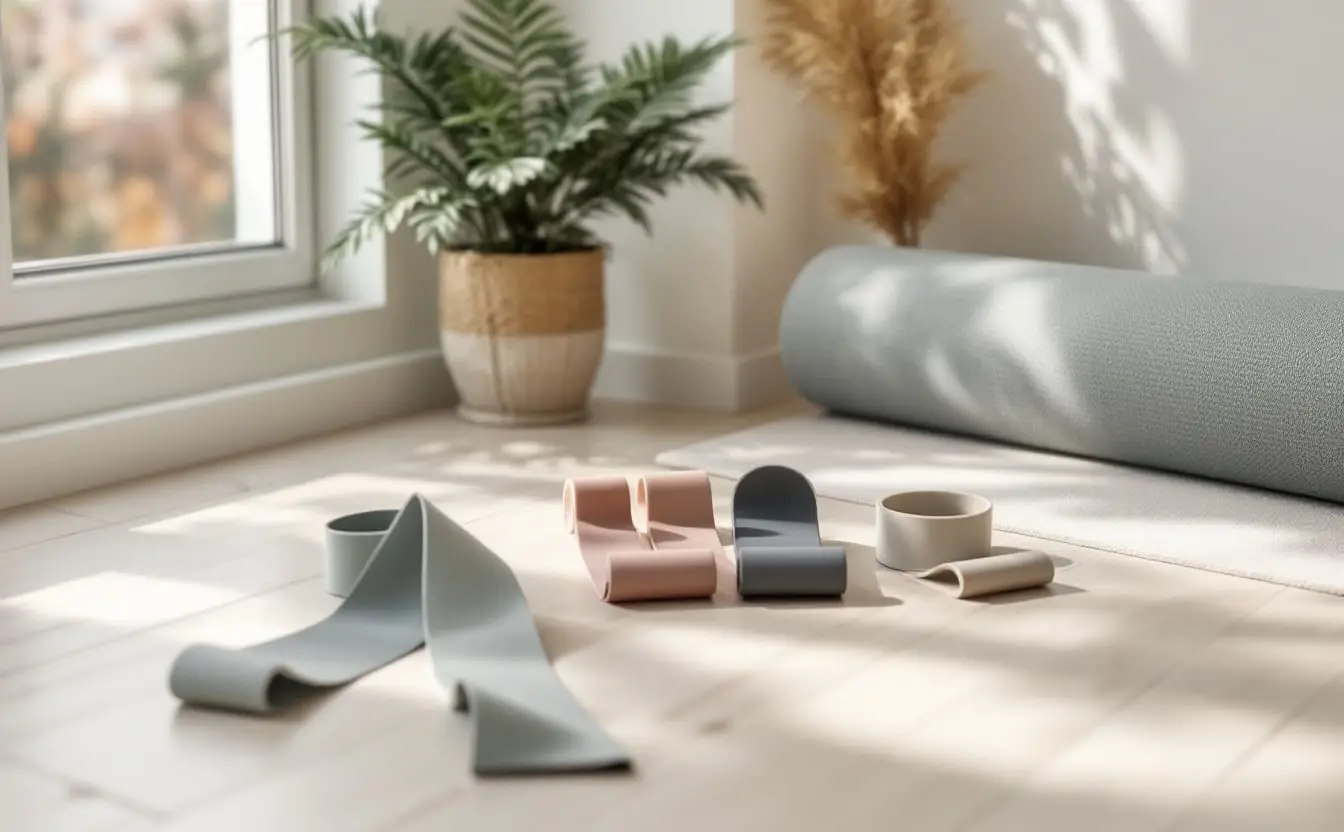
A resistance band set for home Pilates should give you a few graded strengths of the band you will use most, and ideally two kinds of band: a long flat band for footwork, rowing and arm work, and a loop for the hips and seat. That pair covers most of the mat repertoire done with props. Add a tube set with handles only if you also want standing, gym-style strength work.
Exercise bands are one of the few pieces of kit worth buying early. They weigh almost nothing, live in a drawer and cover months of progress, because when one strength gets easy the next is already in the bag. What makes buying them awkward is the packaging. Sets come in dozens of combinations, colour codes change from maker to maker, and the bigger the box, the more filler it tends to hold. This guide is about choosing the set. For what to do with it once it arrives, my earlier piece on resistance bands for home Pilates has a full 25-minute session.
Five resistance band sets, side by side
Each of these does one type of band well. None of them covers everything, and that is deliberate: most people are better served by two small, well-chosen sets than by one enormous box.
| Pick | Best for | Key facts |
|---|---|---|
| Fit Simplify mini loop bands, set of five | A first set for bridges, clams and side steps | Five latex loops in graded, colour-coded strengths; about 12 by 2 inches (30 by 5 cm); carry bag and guide |
| Fabric hip bands, set of three | Hip and seat work on bare legs | Three strengths; woven fabric with a non-slip lining inside; wider than latex loops, so they roll less |
| THERABAND long flat bands | Footwork, rowing, arm work, assisted roll-ups | About 5 feet by 4 inches (1.5 m by 10 cm); flat latex sheet; colour-coded strengths from a long-standing therapy brand |
| WHATAFIT tube bands with handles | Standing presses, rows and curls | Five latex tubes that clip together; handles, ankle straps and a door anchor; carry bag |
| Fit Simplify tube band kit, 12 pieces | A second tube kit for a shared home corner | Several tubes with handles; door anchor and ankle straps; printed instruction booklet |
We put this shortlist together from the makers' specifications, published reviews and how each type of band suits Pilates-style work at home. We have not tested these bands ourselves, so read the table as a starting point and the sections below as the way to decide.
Exercise bands for working out: three families
Resistance bands for working out sort into three families: loops, long flat bands and tubes with handles. Loops split again into thin latex mini loops and wider fabric ones. Each does a different job on the mat.
Mini loops
A mini loop is a small closed band, usually about 12 inches long and 2 inches wide (30 by 5 cm) when laid flat. In Pilates it sits just above the knees or ankles and adds load to the side-lying leg series, clams, bridges where you press the knees apart, and standing side steps. Round the wrists, a light one turns a wall slide or an overhead reach into work for the small muscles around the shoulder blades. A set of five takes you from the lightest to the heaviest without changing anything about the exercise except the colour. The weakness is comfort. Thin latex rolls into a cord on bare thighs and pinches, and it can snap once it has a nick.
Fabric loops
A fabric loop does the same hip work as a mini loop, but it is woven, wider and lined with a grippy strip on the inside, so it stays flat on your legs. Fabric hip bands are the answer if you train in shorts or have given up on latex loops that ride up. They stretch less. That suits short-range moves like clams, bridges and side steps, and makes them too stiff for most arm work or anything with a long range. Three strengths is usually plenty, because the jumps between them are large.
Long flat bands
A long flat band is an open strip of latex or a latex-free material, like a wide ribbon. The physio-style ones are about 5 feet long and 4 inches wide (1.5 m by 10 cm). This is the band that comes closest to the reformer. Round the ball of the foot it gives you Footwork on your back; held in both hands it gives you rowing, Chest Expansion and side bends; looped round the feet it can help you through a Roll Up you cannot yet manage on your own. Because the ends are free, you set the load by where you hold it, so one band covers more than its colour suggests. Long flat therapy bands in two or three strengths are the single most useful thing on this page.
Tubes with handles
Tube sets are rubber tubes with clips at each end, so you can attach handles, ankle straps or a door anchor, and stack two or three tubes for a heavier pull. They are made for standing presses, rows and curls. The door anchor lets you pull from chest height, which a loop or a flat band cannot do without something to tie it to. Tubes are less suited to Pilates footwork, because a hard handle round the arch of the foot is uncomfortable. Buy them if your week includes strength sessions as well as mat work. Skip them if it does not.
What resistance band should I use?
For Pilates, start lighter than you think. The work is about control through the whole movement, especially on the way back, and a band that is too strong makes you shorten the range or brace in the wrong places: shoulders creeping up, back arching, pelvis rocking in the side-lying work. Legs are much stronger than arms, so most people end up with different strengths for each.
A rough starting point:
- Arm work with a long flat band (rowing, Chest Expansion, pull-aparts): the lightest or second-lightest.
- Footwork with a long flat band: a medium strength, or a light one held shorter.
- Clams and side-lying leg lifts with a loop: light to medium. A heavy loop tends to make the top hip roll back.
- Bridges pressing out into a loop: medium to heavy.
- Standing rows and presses with tubes: one medium tube, then stack a second before reaching for the heaviest single tube.
Move up a strength when the last two or three repetitions feel easy and tidy, not before. If you would like a plan built around the band you already own, the resistance band chart prints a table of moves with sets and reps for a mini loop, a long flat band or a tube.
Strengths and colour codes vary by brand
There is no shared colour standard for exercise bands. Inside one set the colours rank the bands from light to heavy, and that is all they do. One maker's green can be another maker's red, and the same colour can mean different strengths in a brand's loops and in its flat bands. Some sets print a resistance figure in pounds on the label. That number is usually measured at one particular stretch, and makers do not all use the same one, so two brands' figures rarely compare.
The practical answer is to judge each band in your hands and, if you mix brands, label them yourself. A strip of masking tape on each band's bag marked light, medium or heavy saves guessing on a dark winter morning.
Materials, sizes and what to leave out
Most bands are natural latex, which stretches smoothly and lasts reasonably well if you look after it. Latex can cause allergic reactions, sometimes serious ones. If you, or anyone who shares your bands, has a latex allergy, choose bands labelled latex-free, which are usually a thermoplastic. Do not assume fabric means latex-free: many fabric loops have rubber threads woven through them, so read the label. The mini loops, the flat bands and the WHATAFIT tubes in the table are all latex.
Size matters most for flat bands. Under about 4 feet (1.2 m) and you run out of band for Footwork and for rowing with straight legs. Wider bands spread the pull across the foot and the palm, which is kinder on the arches and the fingers. For loops, the standard length of about 12 inches (30 cm) laid flat fits most people above the knee.
Things to leave on the shelf:
- Power loops, the long, thick closed bands made for assisted pull-ups. They are far too heavy for Pilates and store a lot of energy.
- Sets padded out with extras you will not use, such as a jump rope or a wall poster. A short list of good bands beats a long list of accessories.
- Combined resistance claims on tube sets, where the box adds every tube together. You will rarely stack all of them at once.
- Thin, unlined latex loops if you always train with bare legs. Choose fabric instead.
- Any set with no strength guide at all, so you cannot tell which band is which.
Care and safety
Bands perish. Heat, sunlight and age make latex brittle, and a band that snaps flicks back towards whatever is nearest. The earlier guide covers care in detail; the short version is this.
- Check every band before a session. Stretch it gently against the light and look for nicks, thin patches and pale streaks.
- Retire a band at the first tear. Never knot a split band back into service.
- Store bands loosely coiled, away from radiators and sunny windowsills.
- Wash fabric loops as the label says; most can be washed by hand and dried flat.
- Keep your face out of the line of pull. Fit a door anchor on the hinge side of a door that is shut firmly, so your pull keeps it closed.
If you are recovering from an injury, managing a joint problem or pregnant, ask a physiotherapist which strengths and moves suit you before you buy a full set.
A long band and a loop also travel well, rolled up inside a shoe. The Pilates travel kit has a hotel-room session built around exactly that pair.
Questions readers ask
Do I need a whole set, or will one band do?
One long flat band in a light to medium strength will carry you through a lot of home Pilates, since you can change the load by changing your grip. A set earns its place once that band gets easy, or when you want a lighter band for the arms and a stronger one for the legs without retying anything.
Are exercise bands as good as a reformer?
They are different. A reformer spring gives a steadier pull and the carriage supports your body, while a band asks you to supply the stability yourself. Bands are a sound way to add load to mat work at home, not a replacement for apparatus classes.
Which resistance band set suits a complete beginner?
A pack of long flat bands in the lighter strengths plus a set of mini loops or fabric loops. Leave tubes and the heaviest strengths until you know you need them.
How long do resistance bands last?
It depends on how often you use them and where you keep them. Latex left on a sunny windowsill or in a hot car perishes far faster than latex kept in a drawer. Check before each session and replace any band with a nick or a tear, however new it is.
Can I use the same bands for strength training outside Pilates?
Yes. Tubes with handles are built for it, and long flat bands handle rows, presses and squats well. Mini loops stay mostly with hips and shoulders, so keep one in your gym bag for a warm-up of side steps before you lift anything heavier.