How to choose a Pilates ring, with six exercises to start
Some links in this story go to shops, and we may earn a commission from them.
How to choose a Pilates ring: resistance, diameter and padded handles, how a magic circle compares with a small ball, three picks and six exercises to start.
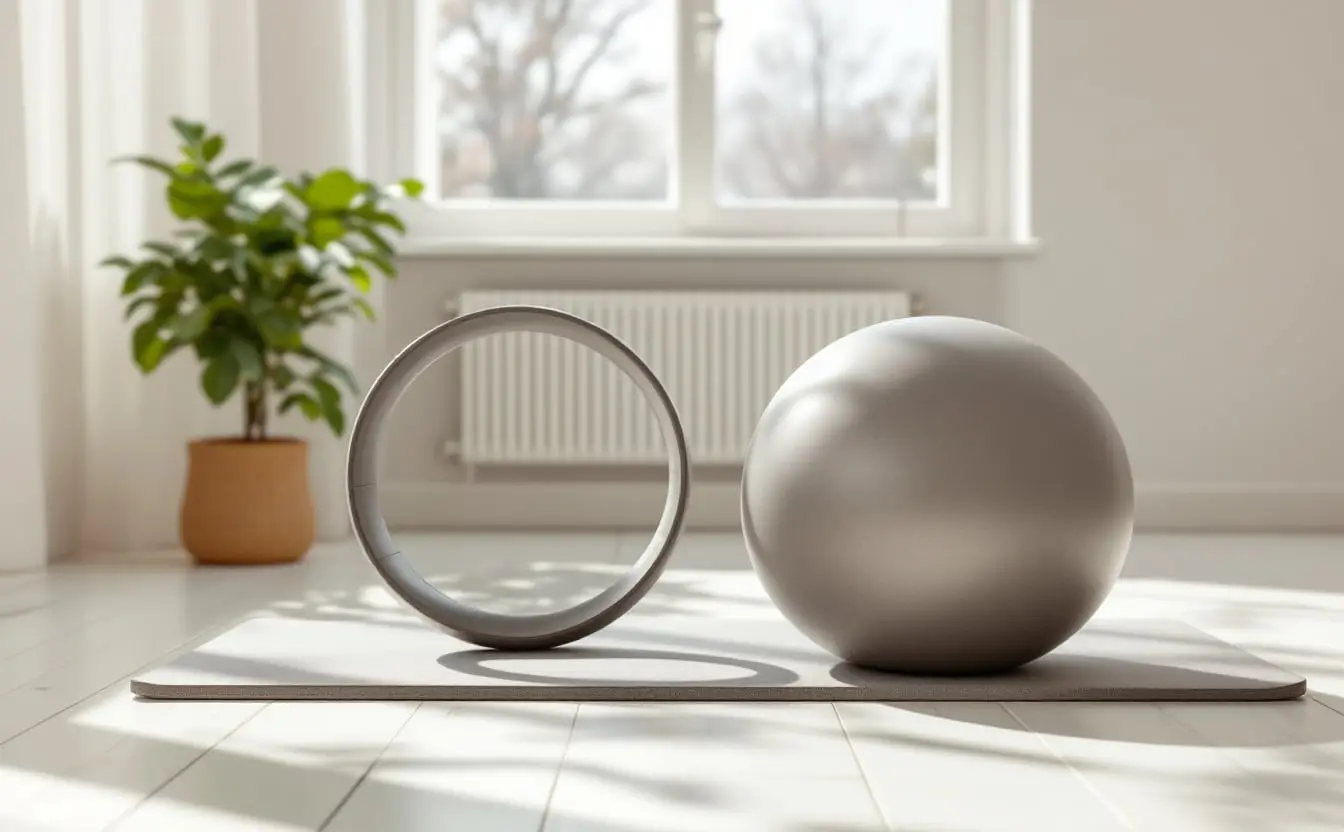
A Pilates ring, often called a magic circle, is a flexible hoop about 14 inches (36 cm) across with a padded handle on each side. You squeeze it, or press outwards against the inner pads, to add light resistance to mat exercises. After the mat itself it is the most useful small prop for home Pilates: it gives the inner thighs, outer hips, arms and chest something to work against, and it tells you at once when one side is pushing harder than the other.
It suits people who already know a handful of mat exercises and want more feedback from them, people who find long bands fiddly, and anyone whose home practice has started to feel the same every time. It is not essential in your first weeks. A firm cushion between the knees will teach the first squeeze just as well, and our guide to building a home Pilates kit puts the ring where it belongs, after the mat and ahead of almost everything else.
Three picks at a glance
| Pick | Best for | Key facts |
|---|---|---|
| ProBody 14-inch Pilates ring | A first ring with medium resistance | 14 inches (36 cm) across; fibreglass core; padded handles inside and out |
| Balanced Body Ultra-Fit circle | Beginners and lighter upper-body work | Lighter resistance; padded grips; made by a company that builds studio apparatus |
| ProBody 9-inch small ball | Gentle squeezes, and support under the back or pelvis | About 9 inches (23 cm); latex-free PVC; inflates with a straw |
We picked these from the makers' specifications, published reviews and how well each one suits Pilates mat work. We have not tested them ourselves, so read the table as a shortlist and check the size and resistance on the listing before you buy.
Kit list
- AIREX yoga and Pilates mat from Power SystemsBest for: a mat that wipes cleanSee it at Power Systems (AIREX yoga and Pilates mat from Power Systems)
- Power Systems yoga and Pilates rangeBest for: equipping a roomSee it at Power Systems (Power Systems yoga and Pilates range)
We may earn a commission from these links.
What a magic circle is
"Pilates ring", "magic circle", "fitness circle" and "Pilates circle" all mean the same thing. It is one of the small pieces of apparatus that came out of Joseph Pilates's own studio, and classical teachers still use it in mat and standing work. A modern ring is usually a band of flexible material inside a padded or rubberised cover, with two pads fixed opposite each other. Each pad has an outer face, for squeezing the ring between your hands, knees or ankles, and an inner face, for pressing outwards when your limbs are inside the ring.
The resistance behaves like a light spring. The further you squeeze, the harder it pushes back, and it opens again as you let go. That return is where much of the value lies. Letting the ring open slowly, instead of letting it bounce, is exactly the kind of control Pilates trains.
How to choose a Pilates ring
Resistance
There is no shared scale for ring resistance, so one maker's "light" can feel like another's "medium". For most adults a medium ring is the sensible first buy: firm enough to feel in an inner-thigh squeeze, soft enough to press between the hands without the shoulders creeping up. Choose a lighter ring if most of your work will be with the arms, if your grip is weak or your hands are small, or if you are coming back to exercise after a long break. A firm ring makes sense mainly for strong, experienced students and for leg work.
A quick test once it arrives: hold it between your palms at chest height and press. If you can bring the pads an inch or two closer for ten slow repetitions without holding your breath or lifting your shoulders, the resistance is right.
Diameter
Most rings are 13 to 15 inches (about 33 to 38 cm) across, and 14 inches is the commonest size. That suits most adults for work between the knees and between the hands. Very petite people sometimes find a 14-inch ring wide between the ankles in side-lying work; tall people rarely have a problem. If you are unsure, 14 inches is the safe middle.
Handles and pads
Look for pads on both faces, inside and outside, so you can press in as well as out. The foam should be dense enough not to flatten under a knee and fixed firmly enough not to twist round the frame. Ridged or contoured pads are a matter of taste. Smooth covers without raised seams are kinder to bare skin in leg work.
Core and construction
Better rings use a flexible core, often fibreglass or a steel band, inside a rubber or foam cover, which keeps the resistance even around the circle. One-piece moulded plastic rings are common at the budget end. Some are perfectly usable, but they can feel softer, flex unevenly or crack where the pads join. A 14-inch ring with a fibreglass core and padding on both faces is a sound example of the first kind, and the lighter circle in the table comes from a maker better known for reformers and studio apparatus.
What to avoid
- Rings sold mainly as thigh toners, with promises about body shape. A ring adds resistance; it does not reshape anything on its own.
- Pads held on with thin plastic clips that can slide round the frame.
- Rings with no inner pads, which limit you to squeezing.
- Bundles where the ring is an afterthought to a long list of extras you will not use.
Kit list
The studio supplier Power Systems sells a 15-inch fibreglass ring with a soft foam cover in two resistances, the kind of ring many gyms buy in quantity.
Six Pilates ring exercises
Keep the press gentle, about half your effort, breathe out as you squeeze and let the ring open slowly every time. These are short descriptions, meant to slot into a mat routine you already know, such as the twenty-minute classical mat sequence, rather than to stand alone as a workout.
Hundred preparation. Lie on your back with your knees in tabletop and the ring between the inner knees. Keep your head down and your arms long by your sides, and breathe in for five counts and out for five while pressing the ring gently, ten breaths in all. You should feel the inner thighs and the lower abdominals working together. Harder: lift your head and shoulders and pump the arms as in the full Hundred.
Leg press to the ceiling. Lie on your back with your legs reaching up towards the ceiling, knees softly bent, and the ring between your inner ankles. Press 10 times, slowly in and more slowly out, with the lower back steady on the mat. Easier: keep the feet on the floor and place the ring between the knees instead.
Outer thigh lift. Lie on your side with both legs inside the ring, the inner pads against the outsides of your ankles. Press the top leg up against the pad 8 to 10 times, then turn over. You should feel the outer hip, with the top hip stacked over the bottom one. Easier: bend the knees and place the ring just above them.
Prone heel squeeze. Lie on your front with your forehead on your stacked hands, legs long and the ring between your ankles. Press the ankles towards each other for a count of three and release, 8 times. You should feel the backs of the thighs and the seat, with the low back long, not pinched. Harder: lift both legs an inch off the mat as you press.
Seated spine twist. Sit tall, legs crossed or straight in front of you, holding the ring between your palms at chest height. Press gently and turn from the waist to one side, return to centre, then turn the other way. Do 4 each side. You should feel the waist and the muscles between the shoulder blades. Easier: sit on a folded towel so the spine can lift more easily.
Standing heel raise. Stand tall with the ring between your inner thighs just above the knees, a hand on a wall or the back of a chair if you like. Press gently and rise onto the balls of your feet, then lower slowly, 10 times. You should feel the inner thighs, the calves and the work of staying upright. Harder: take your hand away from the support.
Pilates ring vs small ball
The ring and the small ball overlap, which is why so many people buy them together and why "Pilates ring and ball" is such a common search. They are not the same tool.
The ring gives springy resistance that builds as you squeeze, with a clear end point, so it suits strengthening work for the inner and outer thighs, arms and chest. Its pads let you press outwards as well as in, which a ball cannot do. It is also the more durable of the two.
A small soft ball, about 9 inches (23 cm) across and only partly inflated, gives a softer squeeze with almost no rebound. Its real strength is support. Slipped under the sacrum, it turns a bridge into a gentle hold. Behind the low back, it props you up as you curl back from sitting. Under the head, it takes some strain off the neck in a chest lift. A latex-free 9-inch ball packs flat when deflated, which makes it the better travel companion.
If you can only have one, choose the ring for resistance and a clear way to progress, and the ball for support and comfort. Most people who keep practising at home end up with both, and use the ball more in the first months and the ring more after that.
Care
- Wipe the pads with a damp cloth and a drop of mild soap after sweaty sessions, and let them dry before you put the ring away.
- Keep it out of direct sun and away from radiators, and never leave it in a hot car.
- Store it upright or hanging, not squashed under heavy objects.
- Let some air out of a small ball for storage, and keep it away from sharp edges and pets.
Safety
- Before each session, check for cracks, splits in the cover and loose pads. Retire a damaged ring.
- When you squeeze between the hands, keep your face out of line with the ring, so that a slipping pad cannot spring towards it.
- Never press the ring against the neck, throat or head, and never stand on it.
- Moderate effort only. The point is control, not a maximum squeeze; if you hold your breath or grimace, ease off.
- If you are pregnant, or have pelvic, groin or hip pain, ask a physiotherapist or a qualified teacher before doing ring work between the legs.
Questions about Pilates rings
What size Pilates ring should I buy?
A 14-inch (36 cm) ring suits most adults and most exercises. Go slightly smaller only if you are very petite and find it wide between the ankles.
Is a Pilates ring good for beginners?
Yes, once you know the basic shapes it adds to. Learn a few foundations first, such as those in our guide to mat Pilates exercises for beginners, then add the ring to two or three of them. A lighter ring is kinder in the first months.
Can a Pilates ring replace a reformer?
No. The ring adds resistance at one point, between two limbs. A reformer moves your whole body against springs on a sliding carriage. They do different jobs, and the ring is a good partner to mat work, not a substitute for apparatus.
How often should I use it?
Two or three sessions a week is plenty, and it need not appear in every exercise. Two or three ring moves inside a mat routine you already do will teach you more than a separate ring workout.
Before your first session, hold the ring at chest height, press it ten times and watch the pads. If one hand is doing more of the work, the ring drifts or tilts instead of closing straight. That small wobble is the first thing a magic circle teaches, and it is worth fixing before you add anything harder.