Three Pilates sessions a week, even as the evenings draw in
Some links in this story go to Amazon and to other shops, and we may earn a commission from them. As an Amazon Associate I earn from qualifying purchases.
How to build a three-sessions-a-week Pilates habit for autumn and winter: where to put the sessions, the shortest one worth doing, and how to keep going.
The clocks go back at the end of October, and for a week or two it feels like a gift. An extra hour in bed. Lighter mornings. Then one evening you look up from the kettle at half past five and it is fully dark, and the summer routine you thought was settled (the walk after work, the mat on the patio, the class you cycled to in daylight) quietly stops.
I have watched this happen to my own practice more than once. The motivation does not vanish. What vanishes is the set of easy cues that made exercise feel like the obvious next thing to do. Autumn asks you to replace those cues on purpose, and if you do it now, before the cold sets in properly, you can carry a steady habit all the way to spring.
The target here is three Pilates sessions a week. Not every day, not a 30-day challenge. Three, for the whole of the dark half of the year.
Why three is the right number
Three sessions is enough to make progress you can feel. Exercises that were shaky in October tend to look different by December when you practise them every other day, because the body has time to adapt between sessions and you are not starting from scratch each time. It also leaves room for the rest days that let that adaptation happen; our piece on rest days and active recovery explains why the day off is part of the training.
It lines up with public health advice too. The NHS asks adults to do strengthening activity that works all the major muscle groups on at least two days a week, and it lists Pilates among the activities that count. Three sessions meets that with one to spare, which matters more than it sounds. The spare session is your buffer for the week a cold or a deadline takes one away.
And three is small enough to survive real life. Five sessions a week looks heroic on paper and tends to collapse at the first busy fortnight. Once a week is pleasant but slow, and a single missed session means a fortnight off. Three sits in the middle.
Kit list
 THERABAND long flat bandsBest for: footwork and rowingSee it on Amazon (THERABAND long flat bands)
 Ozaiic grip socks with ballet-style strapsBest for: strappy reformer socksSee it on Amazon (Ozaiic grip socks with ballet-style straps)
We may earn a commission from these links. As an Amazon Associate I earn from qualifying purchases.
Give each session a fixed home
The biggest change you can make is to stop deciding. A session that lives in your head as "sometime on Tuesday" competes with every other thing Tuesday brings, and by eight o'clock the sofa usually wins. A session that lives at "Tuesday, 6.15pm, front room, before supper" is a plan.
Pick three days with a gap between at least two of them. Monday, Wednesday and Saturday works for a lot of people, as does Tuesday, Thursday and Sunday. Then give each a time that is attached to something already fixed in your day:
- Straight after you get home and change, before you sit down.
- First thing, before the house wakes, if you are a morning person (the mornings are darker in winter too, so a lamp and a warm room matter).
- At lunchtime, if you work from home and can close the laptop for 25 minutes.
- At a booked class, if you want one session a week that someone else is expecting you at. Our guide to finding a good Pilates studio covers what to look for.
A class is a strong anchor because it costs money and has a start time. Many people find that one class plus two home sessions is the combination that lasts, with the class keeping the home sessions honest.
Three sizes of session
The habit fails when every session has to be a full one. So decide in advance what counts. I think of it as three sizes, and all three earn a tick on the calendar.
| Size | Time | What it looks like | Use it when |
|---|---|---|---|
| Full | 40 to 55 minutes | A studio class, or a longer home session with mat work and some band or standing work | You have the time and the energy |
| Standard | About 20 minutes | A short classical mat order, done carefully | Most home sessions |
| Minimum | 8 to 10 minutes | Breathing, Pelvic Curl, the Hundred with your feet down, Spine Stretch Forward, Swan preparation, a minute lying still | You are tired, busy or not quite well |
For the standard size, our twenty-minute classical mat sequence is a good default, because the order is fixed and you do not have to think. The minimum is the one that saves the habit. It is short enough that "I have no time" stops being true, and once you are on the mat you will often keep going for longer. If you do not, that is fine. You did the session.
The one rule I would keep: never let two planned sessions in a row disappear entirely. Miss one, and the next one happens even if it is the minimum.
Get the room ready before you need it
Dark evenings make the gap between thinking about exercise and doing it feel wider. Much of that gap is practical, and you can close it in advance.
Warmth comes first. A cold room makes the body stiff and the mind reluctant, so put the heating on 20 minutes before your session, or move the mat to the warmest room in the house. Lay a folded blanket under the mat if the floor is cold through it. Wear layers you can peel off: a long-sleeved top over a vest, socks with grips that come off once you are warm.
Then light. A big overhead light at 7pm can feel harsh; a lamp at floor level feels like an invitation. Keep the phone in another room, or on aeroplane mode with a timer running.
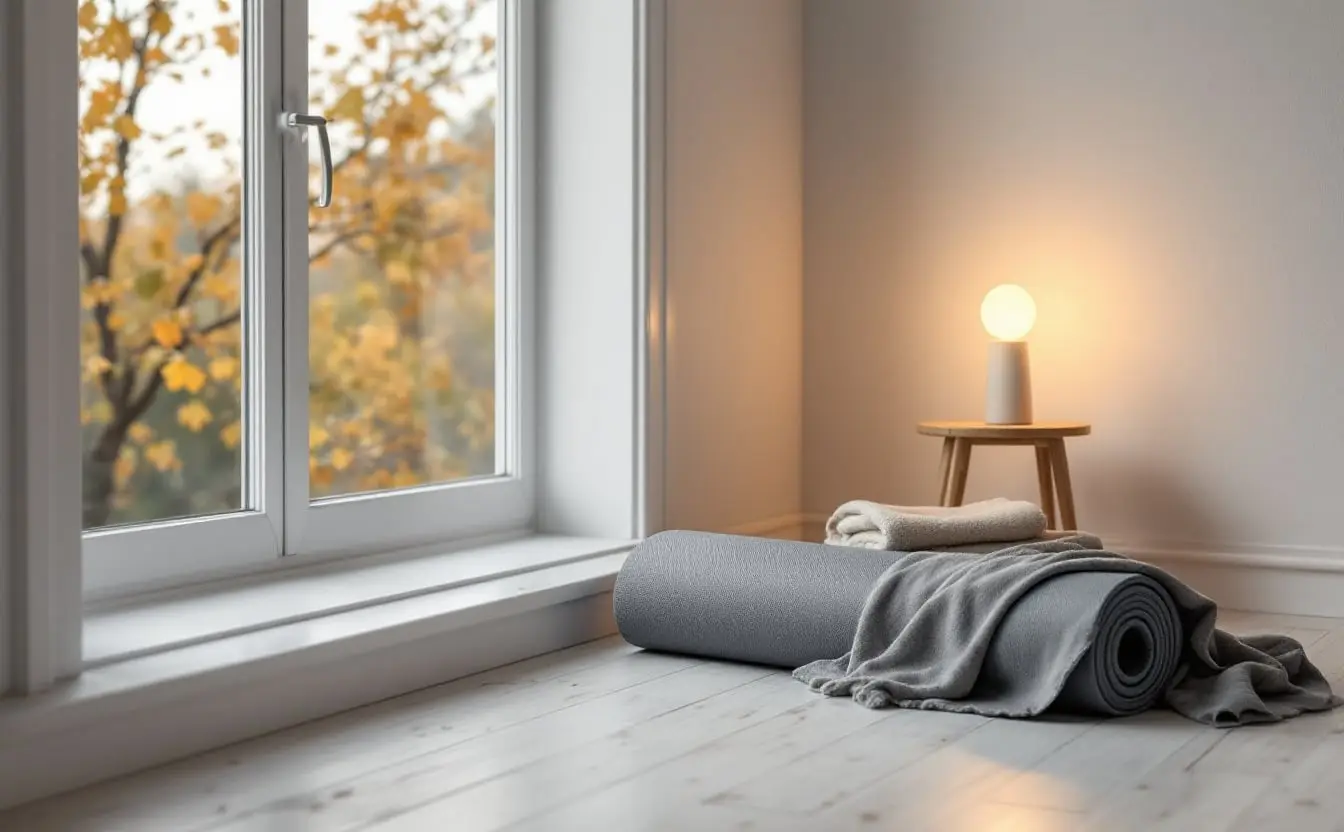
Finally, leave the mat out. A mat rolled in a cupboard is a small decision you have to make every time. A mat lying open by the radiator is already halfway to a session.
Keeping going through the winter
The first two weeks of a new routine are usually easy. Novelty carries you. The hard stretch tends to come later, when the evenings have been dark for a month, the weather turns properly cold and the novelty has worn off. In my experience it lands somewhere around the middle of November. Expect it, and plan for it.
A few things help:
- Write the sessions in your diary for a month at a time, not week by week.
- Keep a plain calendar on the fridge and tick each session. Three ticks a week is the goal; seeing a whole row of them is oddly satisfying.
- Swap rather than skip. Can't do Wednesday? Move it to Thursday, the same evening you notice.
- Change one thing every few weeks so you do not get bored: a new exercise, a different class, the band work you have been ignoring.
- Plan a lighter December now. Three minimum sessions a week through the party season still counts, and it means January starts from a habit rather than from zero.
Colds and winter bugs will interrupt you at some point. A common rule of thumb is that with mild symptoms above the neck, such as a runny nose, gentle movement may feel fine, while a temperature, aching all over or anything in the chest means rest. If you have a health condition, have had an injury, or are unsure whether exercise is right for you after an illness, check with your GP or a physiotherapist before you carry on.
A Sunday ten minutes
The habit is built on Sunday evening as much as on the mat. This short check is what keeps the three sessions in place:
- Look at the week ahead and find the three slots, with times.
- Mark which one is most likely to shrink to a minimum session, and accept that now.
- Check the room: mat out, blanket handy, socks in the drawer by the door.
- If a class is one of the three, book it now, not on the day.
- Glance at last week's ticks. If a session went missing, ask what got in the way and move that slot.
- Choose one thing to pay attention to this week, such as keeping the neck long in the Hundred, or breathing wide into the back of the ribs.
That last point matters more than it looks. A habit kept for its own sake gets dull by Christmas. A habit where you are quietly getting better at something, a steadier Roll Up, a calmer Hundred, carries you through to the lighter evenings without much effort.
Tonight, before you draw the curtains, unroll the mat by the radiator and leave it there.