Why your neck aches in Pilates, and what to do about it
Some links in this story go to shops, and we may earn a commission from them.
Head lifts in the Hundred and the Roll Up often leave the neck sore. Why it happens, the cues and props that help, and when to rest your head on the mat.
Plenty of people come out of their first few mat classes feeling the work most in an unexpected place: the front of the neck. The Hundred, the Roll Up and the whole stretch series ask you to lift your head off the mat and keep it there, and for many of us the neck tires long before the abdominals do. It aches, it trembles, and a ropey feeling under the jaw can hang around into the evening.
This is common, it is usually fixable, and it rarely means you are doing Pilates wrong in some deep way. It is mostly mechanics: a heavy head on the end of a long lever, a chin in the wrong place, and abdominals that run out of steam before the counting does. Each of those has a practical answer.
Why the neck ends up doing the work
A heavy head on a long lever
An adult head weighs roughly five kilograms, about the same as a large bag of potatoes. Standing up, that weight sits more or less on top of the spine, and the neck muscles mostly steady it. Lie on your back and lift it, and you are holding the same weight at right angles to gravity at the far end of the neck. For the muscles at the front of the neck, that is about the hardest position there is.
The deepest of those muscles, the deep neck flexors (longus colli and longus capitis), lie close to the front of the vertebrae and are suited to steady, low-level holding. Over them sit bigger, more superficial muscles: the sternocleidomastoid, the two straps you can see running from behind each ear to the breastbone, and the scalenes at the sides of the neck. When the deep layer is not doing its share, or has simply tired, the superficial layer takes over. Those muscles are strong, but they tend to pull the head forward rather than curl it, they tire in long holds, and they double as helper muscles for breathing, so they grip harder whenever the breath gets short.
Where the chin goes
You can see the switch from one layer to the other in the chin. With the deep flexors working, the head nods slightly before it lifts, the chin draws a little towards the throat and the back of the neck stays long. When the superficial muscles take over, the chin juts up towards the ceiling and the face leads the movement. Teachers often call this a poking chin, and in the classes I have taken it is the usual culprit when someone rubs their neck after the Hundred.
The opposite fault exists too. Crushing the chin onto the chest, sometimes the result of an old 'chin to chest' cue taken literally, squashes the throat, closes down the breath and still loads the neck. The useful position sits between the two: roughly the space of a small orange between chin and breastbone, with the eyes looking towards the thighs or knees.
When the abdominals run out
A head lift is not really a neck exercise. In the Hundred, the stretches and the Roll Up, the upper abdominals curl the ribcage towards the pelvis, and the head and neck ride on top of that curl as the end of the arc. While the trunk holds the curl, the neck only has to keep the head in line with it. The deeper trunk muscles that make this possible are covered in our piece on core strength for a long life.
When the abdominals tire, the curl sinks. The shoulder blades drift back onto the mat, the upper back flattens, and the head stays where it was. Now the neck is holding the head up with much less support underneath it, often with the chin poking forward to make up the difference. That is why so many people feel fine for the first fifty counts of the Hundred and miserable for the last fifty. The neck is not the first thing to fail. It is the thing left holding the weight after something else has stopped. I made a similar point about fatigue and form in the piece on precision over repetitions: once the curl has gone, extra counts are mostly practice at straining your neck.
Two smaller habits add to the load. Holding the breath tightens the scalenes and the muscles around the collarbones, so lateral breathing into the back and sides of the ribs helps keep the front of the neck quieter. And shoulders creeping up towards the ears shorten the space the neck has to work in. A gentle widening across the collarbones is usually enough. There is no need to force the shoulder blades down your back.
Kit list
- Power Systems yoga and Pilates rangeBest for: equipping a roomSee it at Power Systems (Power Systems yoga and Pilates range)
We may earn a commission from these links.
What a good head lift looks like
A well-organised head lift has a clear order. The head nods first, a small movement at the very top of the neck, as if you were quietly agreeing with someone. Then the neck follows, then the upper back peels off the mat to about the bottom tips of the shoulder blades. The breastbone softens down rather than lifting towards the chin, the ribs stay heavy, and the abdomen draws in and down without bulging.
From the outside, the line from the back of the head through the upper spine looks like one smooth curve with no kink at the neck. From the inside, the effort should sit in the front of the trunk, with the neck working but not burning. A simple test: if you could not hum while holding the position, something is gripping.
Exercise by exercise
| Exercise | What usually goes wrong | What to try |
|---|---|---|
| The Hundred | Curl sinks in the second half, chin pokes, breath held | Head down for the second fifty counts, or legs higher so the trunk has less to do |
| Roll Up | Head throws forward to start the roll | Nod first, roll bone by bone, bend the knees or hold the backs of the thighs |
| Single Leg Stretch | Head bobs with each change of legs | Fix the eye line on one spot and slow the tempo |
| Double Leg Stretch | Head drops back as the arms reach overhead | Shorten the arm reach, or keep the hands by the shins and only extend the legs |
| Single Straight Leg Stretch | Chin jams down to reach the leg | Lower the leg a little and keep the orange-sized gap |
| Criss Cross | Hands pull the head round, chin swings to the shoulder | Hands cradle without pulling, turn from the ribs, elbows stay wide |
| Roll Over | Weight rolls onto the back of the neck | Stop on the shoulder blades, never on the neck itself |
The last row is a rule rather than a tip. In the Roll Over and anything else that takes the legs overhead, the weight belongs on the shoulder blades and never on the cervical spine.
Props and hand positions that take the load
You do not need to suffer through long head lifts while the deep neck muscles catch up. A few simple supports change the job a great deal.
- Hands behind the head. Interlace the fingers and cradle the base of the skull, elbows wide enough that you can just see them at the edge of your vision. The hands carry part of the head's weight. The only rule is that they support and never pull the head forward.
- A towel sling. Lay a hand towel across the mat under your head and hold one end in each hand. Lift with the towel cradling the back of the head so the arms share the load. It is a good way to rehearse the shape of the movement while the deep neck muscles build up.
- A folded towel or small flat cushion. For head-down work, a pad a few centimetres thick under the back of the head stops the chin tipping towards the ceiling, which is common if your upper back is naturally rounder. Aim for a face roughly parallel to the ceiling, not a chin pushed onto the chest.
- The reformer headrest. Most reformers have a headrest that can be raised or lowered. The raised position is often kinder for a stiff neck or a rounded upper back during footwork and other head-down work. Ask the teacher before you change it.
A short drill: the nod and curl
This is the movement worth practising on its own, a few times a week, before you ask the neck to hold a long Hundred. Versions of this small nod are widely used in neck rehabilitation, and it suits Pilates well because it teaches the order the head lift needs.
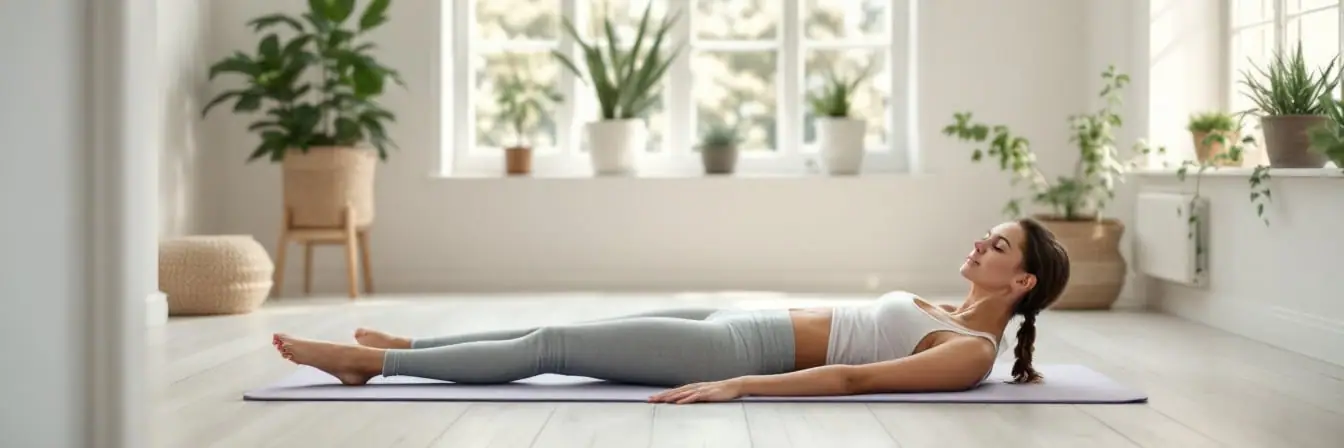
- Lie on your back with knees bent and feet flat, hip-width apart. Put a folded towel under your head if your chin tips up.
- Breathe into the back and sides of the ribs for three or four breaths. Let the jaw unclench and the tongue rest on the floor of the mouth.
- Without lifting the head, make a tiny nod. The back of the head slides slightly along the mat and the back of the neck lengthens. Hold for five seconds while breathing, then release. Repeat 5 times.
- Nod again, then on an exhale keep curling: head, neck, then upper back to the tips of the shoulder blades, eyes towards the knees. Support the head with your hands if you like. Hold for two slow breaths, then roll down in reverse. Repeat 5 to 8 times.
- If the chin starts to poke or the front of the neck burns, stop and rest. A few good repetitions build the right pattern; extra poor ones build the old one.
Over a few weeks most people find they can hold the curl a little longer before the chin wanders. The progress is slow and unglamorous, and it is real.
When to put your head down
Putting the head down is not giving up. The exercises still count with the head resting: the legs, the breath and the abdominal work carry on. Rest your head on the mat when:
- the front of the neck burns, trembles or feels ropey;
- the chin pokes up, or you can no longer see your knees without straining;
- you notice you are holding your breath or clenching your jaw;
- the upper back has sunk onto the mat and the curl has gone;
- a headache starts to build at the base of the skull.
Rest for a few counts, then lift again with a fresh nod if it feels right. Doing the first half of the Hundred lifted and the second half down, for weeks or months, is a perfectly respectable way to train.
Some situations call for more than a towel. If you have osteoporosis or low bone density, repeated forward bending of the spine under load is something to talk through with a qualified professional, and in-person guidance is worth having. And if neck pain lasts more than a couple of weeks, keeps coming back, spreads into the shoulder or arm, follows a fall or accident, or comes with pins and needles, numbness, weakness, dizziness or headaches, see your GP or a physiotherapist rather than training through it.
For the ordinary ache, the fix is usually smaller than people expect. Next time you lie down for the Hundred, give that tiny nod before the arms start pumping, find the orange under your chin, and notice how many more counts you get before the neck asks you to stop.