How to plan a bathroom that suits you after class
Some links in this story go to shops, and we may earn a commission from them.
Tired legs and a high bath rim do not mix. How to think about warmth, light, the floor and a shower conversion before you change the room.
After a Tuesday class I stand at the side of the bath, one hand on the tiles, lifting a leg over a rim that felt lower ten years ago. My legs are pleasantly tired. The tiles are cold. It is not a crisis, just a small daily negotiation.
Plenty of readers, especially those of us who came to Pilates later in life, have the same moment at home. Where a bathroom no longer suits you, a local firm offering bathroom remodeling Scottsdale AZ residents can talk to, or one near wherever you live, can help you think it through. This piece is about the room itself: what makes a bathroom easy and pleasant to use after you have trained, and how to plan a change calmly.
Notice how you actually use the room after class
Before you think about tiles or taps, spend a week paying attention. Bathrooms are used half asleep in the morning and tired in the evening, and after a class you are often both warm and a bit wobbly in the legs. That is the version of you the room needs to suit, not the brisk one who chose the fittings years ago.
Notice where you put your hand when you step in and out of the bath or shower. Notice whether you sit on the edge of the bath to dry your feet, and whether that feels steady. Notice the floor when it is wet, the light when it is dark outside, and whether you can reach the towel without turning round on one foot. None of this needs a notebook, although I found one helpful. It simply gives you something honest to say when someone asks what you want.
I would add one more observation: how warm the room is. A bathroom that is cold in the morning makes everything stiffer, and you will hurry, which is rarely a good idea on a wet floor.
Kit list
- Power Systems yoga and Pilates rangeBest for: equipping a roomSee it at Power Systems (Power Systems yoga and Pilates range)
We may earn a commission from these links.
Think about warmth, light and the floor first
These three come before anything showy. A warm room lets you take your time. Good light, including something soft for night-time trips, means you are never feeling for the edge of the bath in the dark. And a floor that is not slippery when wet is worth more than any number of beautiful fittings.
In a hot, dry climate like the Arizona desert, warmth may be the least of your worries for much of the year, although desert mornings and evenings can be cool and a tiled bathroom holds the chill. Elsewhere, and certainly in Edinburgh, warmth is the first thing I would ask about. Either way, it is worth asking a professional how the room is heated and ventilated, and how it will feel at both ends of the year.
For the floor, ask about surfaces that keep their grip when wet and are comfortable under bare feet. For light, ask about even, glare-free light over the basin and something lower and gentler for the small hours. These are questions for the people who will do the work, and a good firm will explain the options without hurry.
Consider the bath, and whether you still want it
Many of us grew up thinking a bath was a treat and a shower was a compromise. After a class, a long, warm soak still has its charms. But getting in and out of a bath is the moment I mentioned at the start, and for some people a level or low-threshold shower suits the life they actually lead now.
There is no right answer here, only the one that suits you. Some people keep a bath because they love it and use it often. Others convert the bath to a shower and find they shower more willingly after training because it is easier. A conversion of a tub to a shower is a common job, and the company you speak to should be able to show you how it would change the layout of your particular room.
If you are planning for the long term, it is sensible to think about how you might want to use the room in ten or fifteen years, not just this spring. I say that not to be gloomy, simply because I would rather do a job once.
Plan the change in a sensible order
Building work in a bathroom takes the room out of use for a while, which is its own small upheaval. Thinking it through in order makes the process calmer. Here is the sequence I would follow:
- Write down what you noticed during your week of paying attention: where you hold on, where you hurry, what feels awkward.
- Decide what you want the room to do, in plain words. "A shower I can walk into", "somewhere to sit while I dry my feet", "warm in the morning".
- Talk to one or two local firms and describe how you use the room, rather than starting with a catalogue. Ask them to explain what is possible in the space you have.
- Ask what the work involves, how long the room will be out of use, and what you will need to arrange in the meantime.
- Ask about anything structural, electrical or plumbing-related, and leave it entirely to them. That work is for trained professionals, not for a keen weekend.
- Think about how you will manage the weeks of work, whether that means a friend's shower after class or using another bathroom in the house.
- Once it is finished, try it slowly, the way you would a new exercise, before you use it half asleep.
None of these steps is complicated. The point of putting them in order is that the decisions about how you live come before the decisions about how it looks.
Keep the details plain and within reach
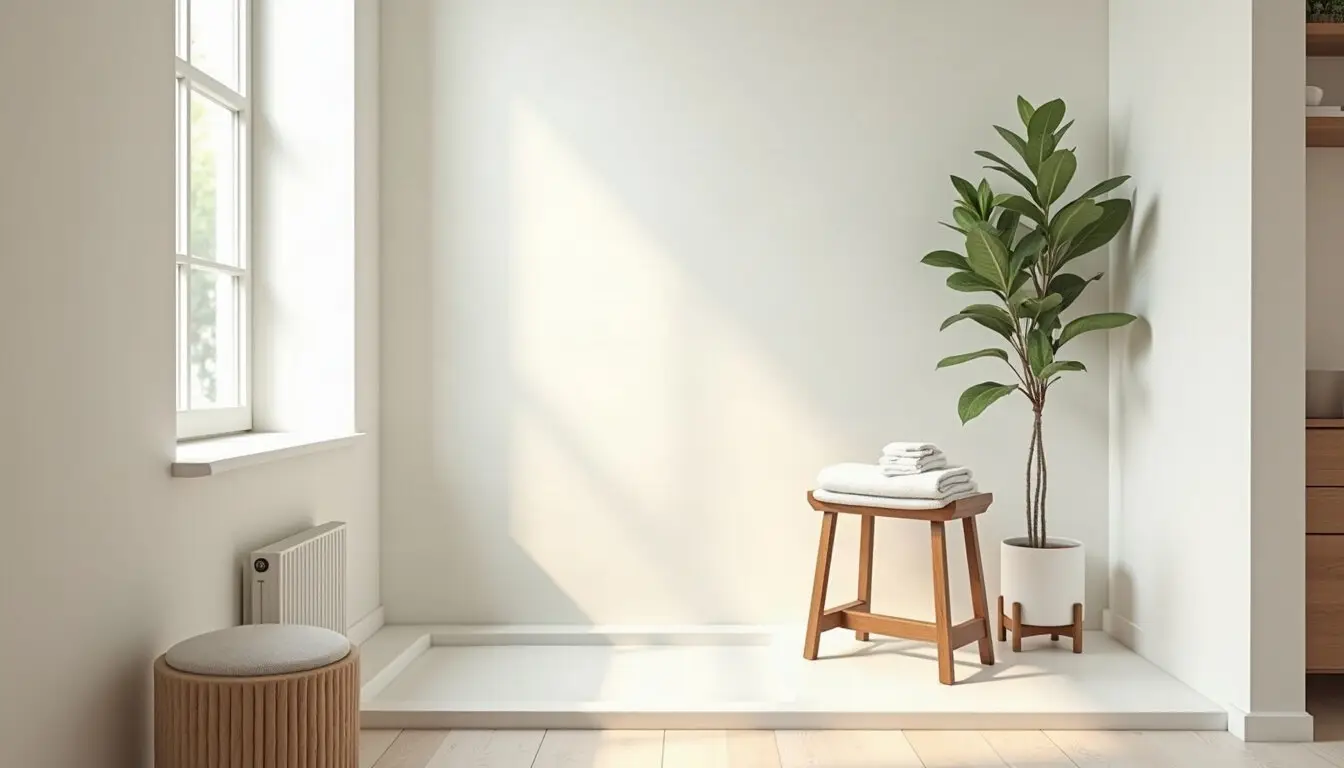
Some of the most useful touches are also the least glamorous. A towel rail you can reach from the shower. A shelf at a height where you do not need to bend to the floor for the soap. A small stool or a built-in seat if you like to sit while drying your feet. A clear floor, with no bath mat that curls at the edges.
Storage deserves a word too. Bathrooms tend to fill up with bottles and half-used jars, and every one of them on the edge of the bath is something to knock over or reach past. A cupboard at waist height, with the things you use daily at the front, keeps the edges clear. It is the same principle as clearing the floor of the room where you practise: fewer things in the way means fewer small decisions while you are tired.
And think about the door. A door that opens inwards into a small bathroom can be awkward to get past when you are carrying towels or clothes, and it is worth asking whether the layout could be easier. Again, the firm you speak to will know what is possible in your particular room, and what would mean moving more than you want to move.
I am wary of turning any of this into a promise. A good bathroom will not, on its own, make you steadier or stronger; your practice does that work, slowly, week by week. What the right room can do is stop getting in your way, so that the half hour after class is a pleasure rather than a negotiation. If you have any particular concerns about balance or a health condition, a doctor or physio who can see you in person is the right person to ask first, before you plan the room around them.
Spring check
Lighter: stop fretting over the colour of the tiles and the style of the taps; they matter least.
Heavier: put your thought into warmth, good light, a floor that grips when wet and an easy way in and out.
The last rep
This week, after your next class, walk into your bathroom slowly and notice the three things that make you hurry or hold on. Write them on the back of an envelope and keep it by the kettle. That small list is the start of a better room, warm and light, with a dry towel waiting within reach.