What staying close to Joseph Pilates's original work means in practice
"Staying close to the original work" is a phrase you hear most often from classical teachers, and it can sound like a slogan until you see what it means on an ordinary weekday morning in a studio. It means a fixed order. It means apparatus built to particular measurements. It means a client moves from one exercise to the next without a pause to chat, reset or reach for a water bottle.
It also carries a view about what the method is for, and that is where the arguments start. I have taken classes in both traditions for long enough to have favourites in each, and to distrust anyone who thinks the other side has nothing to teach. What follows is an attempt to describe the difference fairly: what classical teachers keep, what contemporary schools changed, and the reasons each would give.
Where the split came from
Joseph Pilates died in 1967, and Clara, who had taught beside him for four decades, died in 1977. Neither left a formal teacher-training curriculum. What they left was a body of exercises, two short books (Your Health in 1934 and Return to Life Through Contrology in 1945), the apparatus, some film, and a group of people who had learned from them directly. Those people taught what they had been taught, filtered through their own bodies and their own clients. Some stayed very close to the New York studio. Others, Ron Fletcher in Beverly Hills being the best-known case, built distinct styles while still crediting Joe.
"Classical" became the usual name for the first group, and especially for the line that runs through Romana Kryzanowska, who taught the system in New York for decades after Joe's death. "Contemporary" covers the schools that took shape from the 1980s onwards, many of them founded or shaped by dancers and physiotherapists who wanted to use the exercises in rehabilitation.
What "original" means in a classical studio
The order
In classical teaching the exercises come in a set sequence, and the sequence is part of the method. The mat work in Return to Life runs from the Hundred to the Push Up, thirty-four exercises in all. The reformer has its own order, opening with Footwork and the Hundred. A beginner gets a short version; an advanced student gets the full thing at pace. Each exercise prepares the next: the Hundred warms the body and sets the breath, the Roll Up then articulates the spine the Hundred has just woken, and flexion is balanced by extension before the session ends.
Transitions
Classical teachers treat the move between exercises as part of the work. You do not sit up, rearrange yourself and wait. You roll, turn or swing into the next position with the same control you used for the exercise. Done well, a forty-five minute classical session has almost no dead time. That is one reason it is harder than it looks from the doorway.
Apparatus and springs
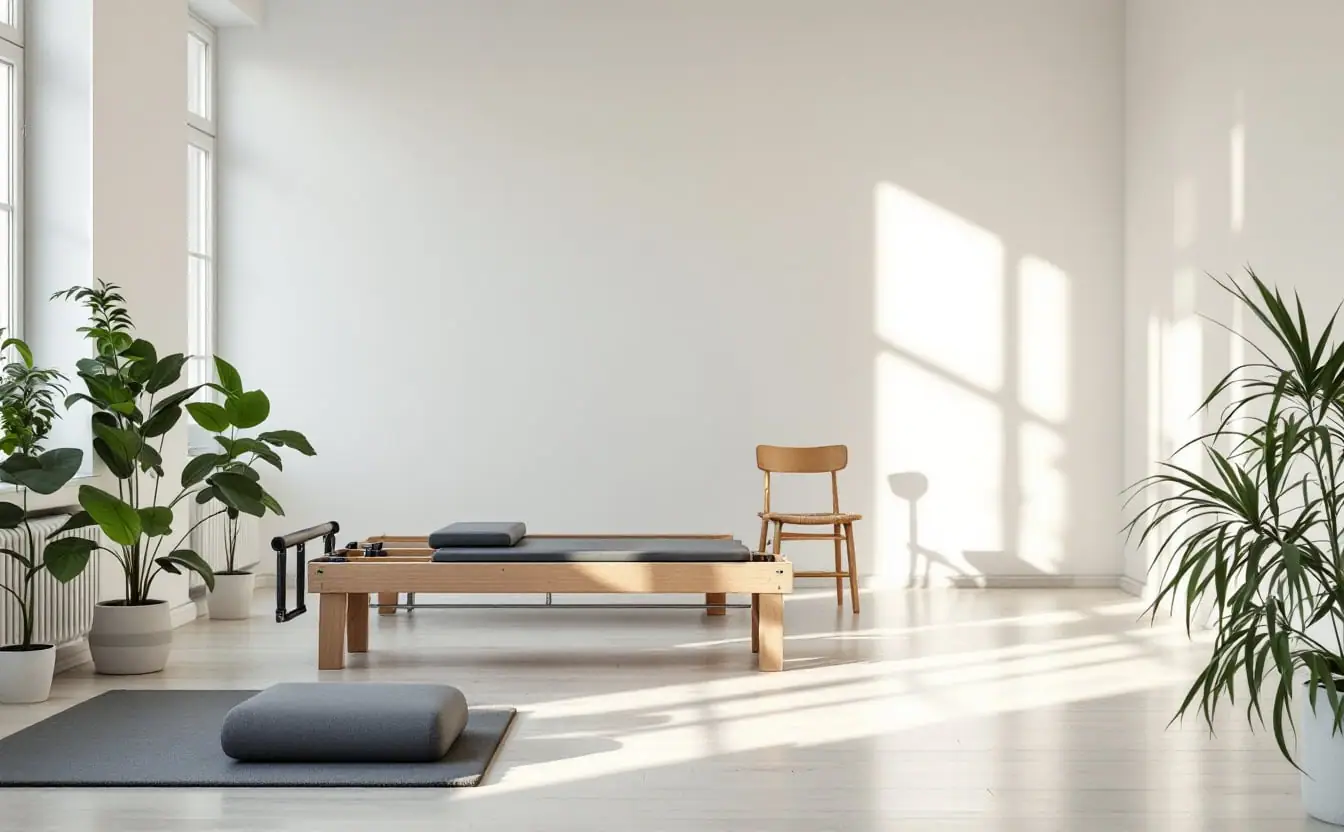
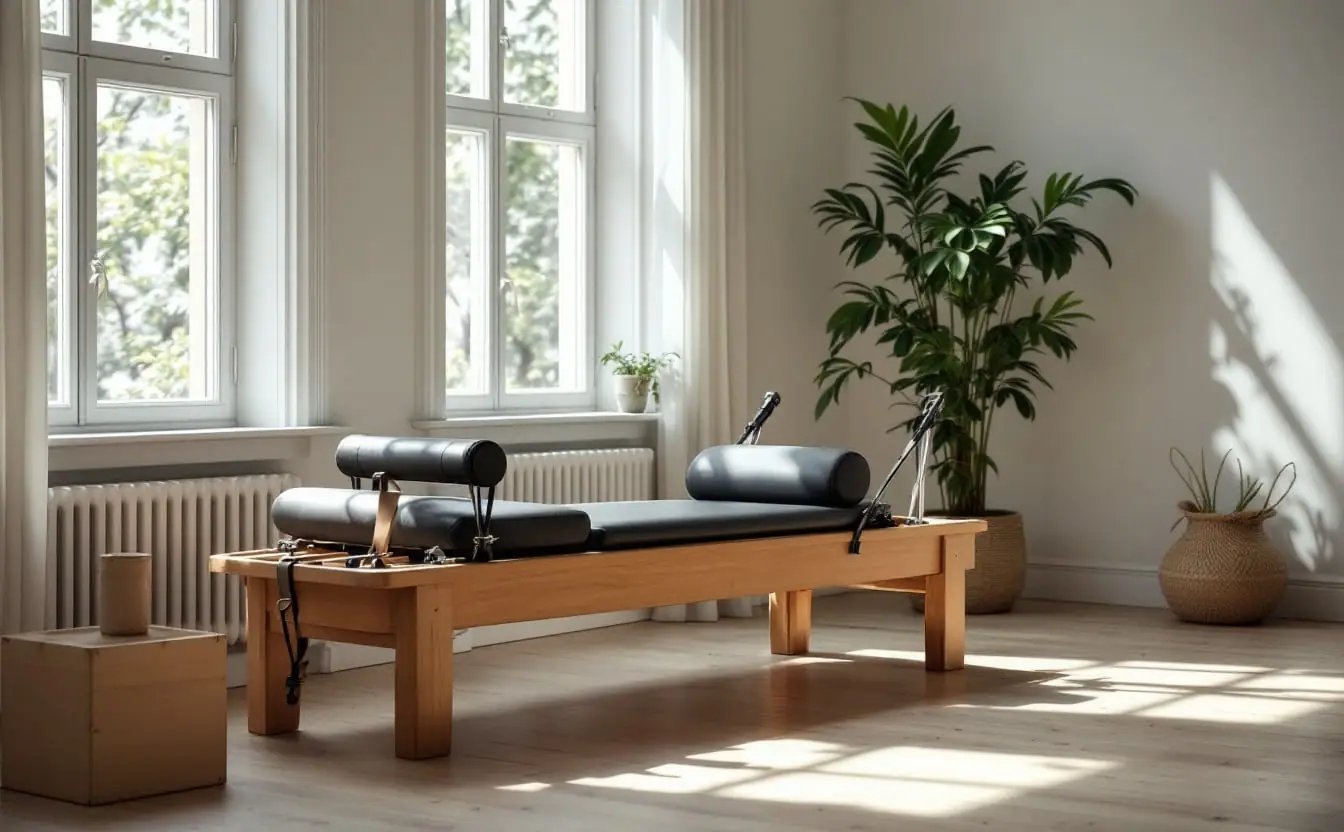
Classical studios tend to use machines built to the original New York measurements: the length of the reformer, the height of the footbar, the width of the box, the feel of the springs. Teachers in this tradition will tell you that a carriage a few centimetres longer, or springs a little looser, changes the exercise. Their reformers usually have fewer spring options, and the client is expected to work against the springs rather than be carried by them.
Vocabulary and shape
Classical teaching has its own language: the powerhouse, the scoop, the box of shoulders and hips, Pilates stance with heels together and toes slightly apart. In many classical lineages the lower back is drawn towards the mat in supine work rather than held in its natural curve.
What contemporary schools changed, and why
Neutral spine
The biggest change was the spine. Many contemporary schools teach a neutral pelvis as the default when lying on the back, keeping the small natural curve of the lower back, and bring in imprinting only where an exercise calls for it. The reasoning came from physiotherapy: train the deep trunk muscles in the posture people actually stand and move in. If you have ever been asked to find the triangle of the pelvis before an exercise, you have met this thinking.
Breaking exercises down
Contemporary teachers often teach an exercise in parts, with preparatory versions and a menu of modifications, rather than as one fixed shape. For someone coming back from injury, or living with a condition that makes certain movements unwise, this can be the difference between doing Pilates and not doing it.
Equipment and props
Contemporary reformers usually have more springs, colour-coded by strength, plus adjustable footbars and headrests, and they come in more sizes. Small balls, foam rollers, rings and bands are common in classes. The aim is finer adjustment for a wider range of bodies.
Order as a choice
Most contemporary programmes teach the classical repertoire, but they treat order as something the teacher designs. One session might focus on hip extension, the next on rotation.
Side by side
| Classical | Contemporary | |
|---|---|---|
| Exercise order | Set sequence, basic to advanced | Designed by the teacher for each session |
| Lower back when lying down | Often drawn towards the mat | Neutral by default, imprint where needed |
| Springs | Fewer options, firm | More options, finer steps |
| Transitions | Part of the exercise, no breaks | Short resets are common |
| Props | Joe's own small apparatus | Balls, rollers and bands widely used |
| Teacher training | Long apprenticeship, heavy on observation | Modular courses, strong anatomy content |
Every row has exceptions. Treat the table as a rough map, not a rulebook.
The fair case for each
The classical argument is about coherence. Joseph Pilates designed a system, not a list of exercises, and if you remove the order, the transitions and the apparatus you are left with something else, possibly useful, but not the same thing. There is a practical point too. A known order frees the teacher to watch the body instead of planning the next move, and it gives the student a clear path from basic to advanced, which is how progression has always worked in classical studios.
The contemporary argument is about bodies. Joe taught mostly fit adults, dancers and athletes, in one New York room. Pilates is now used after surgery, with older beginners, in pregnancy and alongside physiotherapy. Adapting the work for those people is not disloyalty. Joe kept redesigning his own apparatus for most of his life, and it is easy to imagine him doing the same.
Both sides overstate their case. Good classical teachers modify all the time; they do it inside the system, by choosing which exercises to leave out and which spring to use. Good contemporary teachers know the original order and can teach it. The weakest teaching in either camp tends to come from people who picked up the vocabulary without the reasoning behind it.
Questions to ask a studio
If the difference matters to you, ask before you book:
- Which school or lineage did the teachers train in, and how many hours did that training take?
- Do sessions follow a set order, or does each teacher design their own?
- What apparatus do you use, and why that maker?
- How do you adapt the work for a back problem, a recent injury or pregnancy?
- Can I watch a class before joining one?
If you have a medical condition or a recent injury, a teacher who asks good questions back matters more than the label on the door, and your GP or physiotherapist should have the first word.
Where I land
My own test is simple. Ask a teacher to take you from the Hundred into the Roll Up without stopping, then ask why the Roll Up comes second. A teacher from either tradition who can answer that clearly, and then adjust it for the body lying on the mat in front of them, is staying close to the original work in the way that counts.