Ten practical ways to declutter your Pilates studio
Most studios do not get cluttered on purpose. A teacher buys a bag of soft balls for one workshop, a supplier sends sample rollers, a client leaves a yoga block behind, and five years later there is a basket of rings nobody touches and a corner where spare straps go to die. The room still works. It just works less well than it did.
Clutter costs more than looks. It slows changeovers between clients, hides trip hazards and makes cleaning harder. It also changes how you teach, because a prop within arm's reach tends to get used whether the session needs it or not. Here are ten fixes, roughly in the order I would tackle them.
The ten
1. Count everything you own
Empty the shelves and baskets onto the floor and make a list: magic circles, small balls, rollers, bands, hand weights, blocks, cushions, spare straps. Next to each item, note when you last used it in a session. Anything untouched for a year goes into one box for the decision in point 10. Be honest about duplicates. A studio with three reformers rarely needs eleven magic circles.
2. Kit out each station, then stop
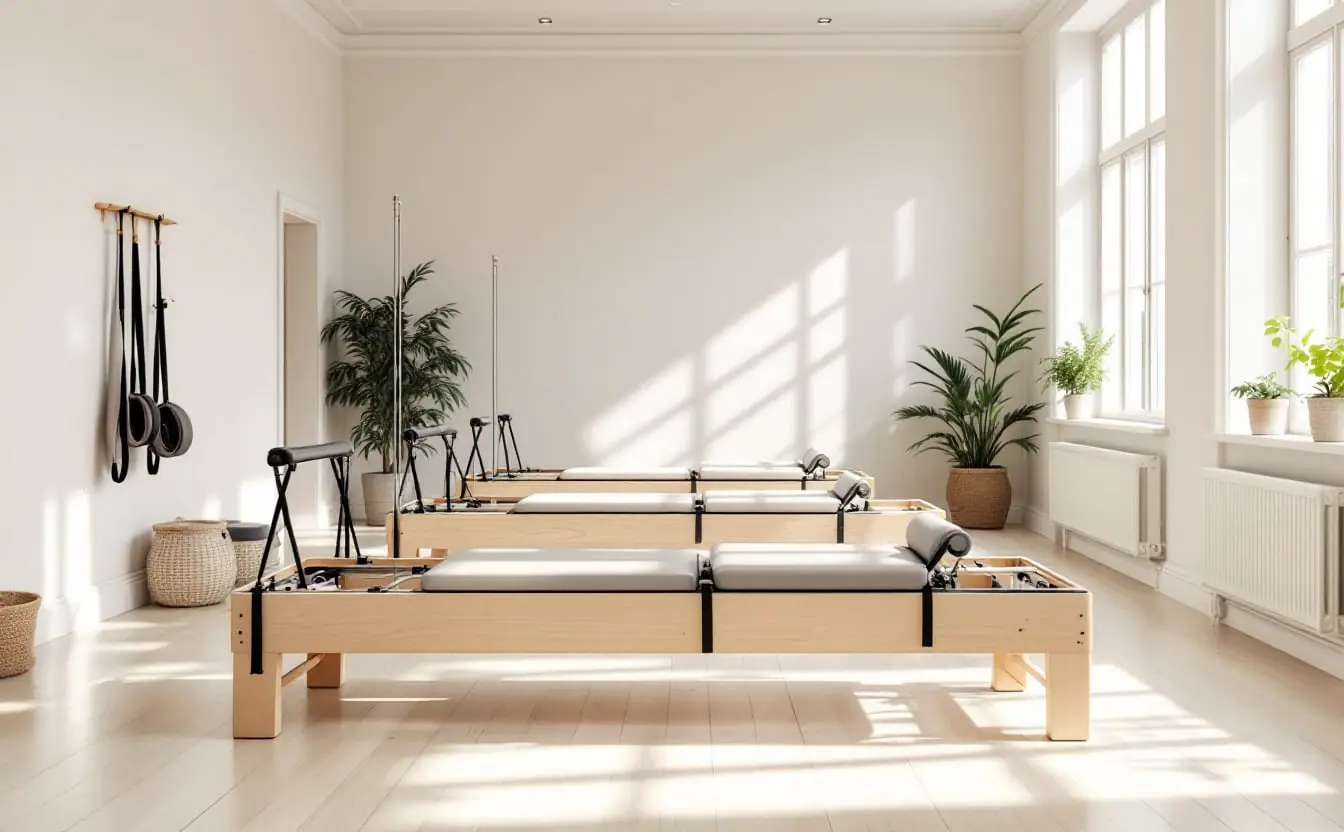
Work out what one client needs at one station for a normal session and give each station exactly that. For a reformer it might be a small head cushion, the sitting box and a pole. Everything else lives in central storage, and workshop extras come out for the workshop and go back afterwards.
3. Store vertically and close to use
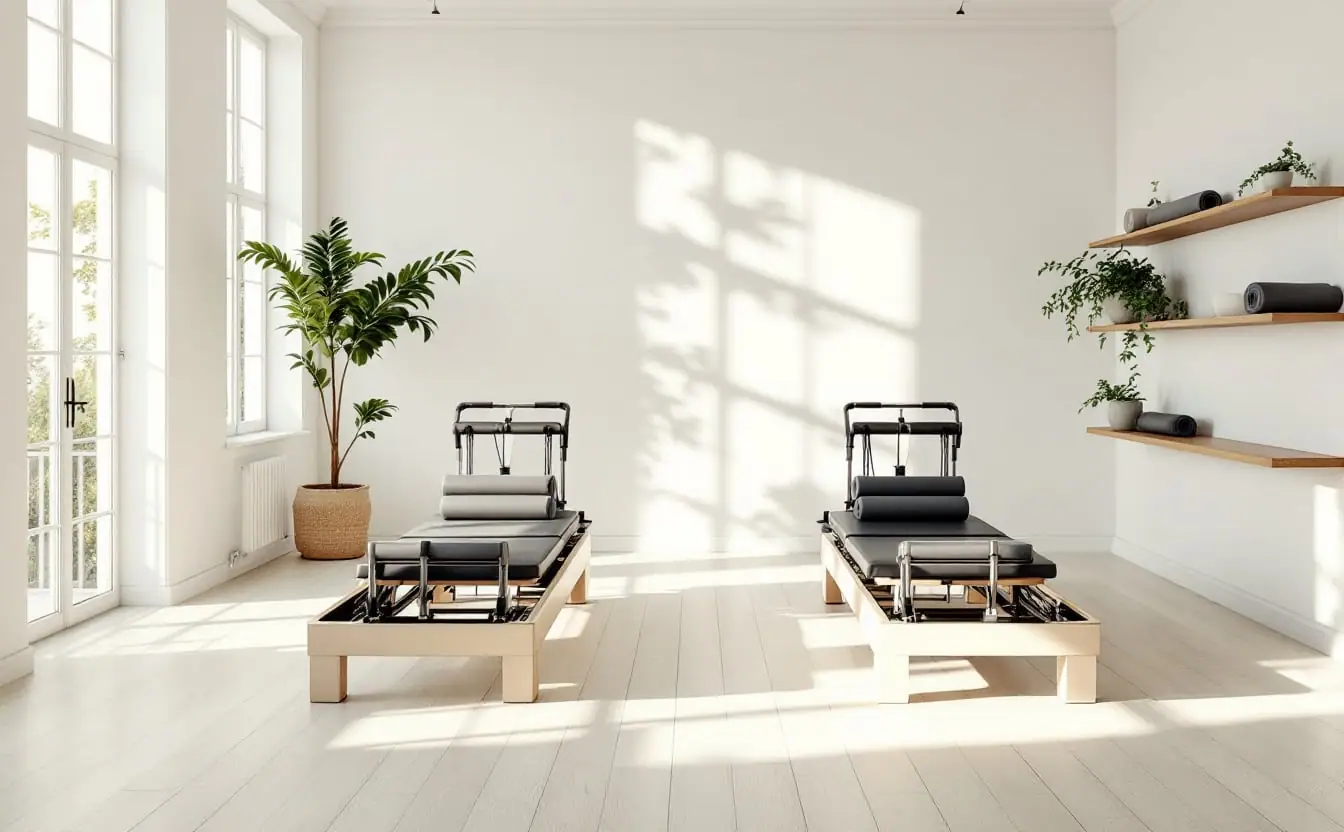
Floor space is the most valuable thing a studio has. Wall racks for rollers and circles, shallow shelves at hip height for small kit and a row of hooks for bands keep the floor clear and let you see everything at a glance. Label the shelves so a client or a covering teacher can put things back without asking. Nothing should live on the floor beside a machine, where a foot will find it.
4. Plan the floor on paper first
Measure the room and every machine, draw the room to scale on squared paper, and cut out paper shapes for the apparatus so you can move them about. Most full-size reformers are a little under 2.5 metres long, and a tower or Cadillac needs headroom as well as floor space. Leave room at both ends of each reformer for you to stand and spot, and keep a clear walkway of at least 90 cm from the door to every machine. The route to the fire exit stays clear at all times; for business premises in the UK that is part of your fire safety duties, not a nicety. In a small room, a reformer with a tower frame can do the work of two separate machines.
5. Give clients' things a home
Bags, coats, shoes and water bottles end up on the floor unless there is somewhere obvious to put them. A row of hooks, a shoe rack by the door and a small shelf for bottles fix most of it. Ask clients to put their own props away at the end of class. Most are happy to, and it saves you ten minutes of tidying between groups.
6. Set a cleaning rhythm
A schedule stops cleaning from being something you do only when the room looks bad.
| When | What to do |
|---|---|
| After each client | Wipe upholstery, footbar, handles and loops with a cleaner suitable for vinyl |
| End of each day | Empty bins, clear every surface, vacuum, open the windows for a few minutes |
| Weekly | Vacuum rails and wheel tracks, wash towels and cushion covers, check straps |
| Monthly | Inspect springs, hooks and ropes, tighten loose fittings, wash small props |
| Each season | Repeat the full audit from point 1 and deep clean storage areas |
Read the manufacturer's care guide before choosing a product for the upholstery, since bleach and strong solvents can dry and crack vinyl over time. Ending each day in a clean room also means the next morning starts calm instead of with yesterday's mess.
7. Retire worn parts properly
Frayed straps, rusty or overstretched springs and split upholstery are clutter with a safety risk attached. Take them out of service straight away and replace them, rather than keeping them "for spares". Real spares (a set of springs, a pair of straps, the right spanner) go in one labelled box so you can find them when you need them.
8. Stagger the timetable
When several clients arrive and leave at once, the room fills with bags, chat and people hovering by machines. If you run more than one private or semi-private session at a time, try starting them 15 or 20 minutes apart so only one person is coming or going at any moment. The studio stays calmer, and you can greet each client properly instead of shouting hello over someone's shoulder.
9. Clear the digital clutter
Paper forms in a drawer, three booking apps and an inbox of unanswered messages are clutter too. Choose one system for bookings and payments and one place for client notes. Health details on intake forms count as sensitive personal data under UK data protection law, so keep them secure, keep paper forms off the desk, and delete or shred old records in line with your retention policy. Switch off notifications during sessions and answer messages at a set time each day.
10. Sell, donate or recycle
Go back to the box from point 1. Sell good equipment through teacher groups or second-hand sites, give usable props to a school, a community hall or a newer teacher, and recycle what is broken. Then put the next audit in the diary for three months' time.
Why fewer gadgets can mean better teaching
Joseph Pilates invented a good deal of equipment, from the reformer to the Magic Circle and the Foot Corrector, but his mat work needs nothing more than the floor. Many of the balls, rollers and gadgets in modern studios arrived much later, from the wider fitness industry rather than from the method. Some earn their place. A small cushion under the head, or a band for a client who cannot yet hold a position, can be exactly right.
The risk is subtler. A teacher sometimes reaches for a prop because a cue did not land, and the prop papers over the gap. Fewer options push you to find better words, clearer hands-on cues and smarter changes to springs and range, the kind of thinking set out in our piece on progressing clients from basic to advanced. A client who learns to find their centre without a ball between the knees has learnt something they can take home.
Clear rooms help clients as well. They can see the space, know where to go and arrive calmer. For teachers running a small studio from home, often as a second career like those in our piece on teaching Pilates after 40, a tidy room is also what separates the studio from the spare room. More on the working side of teaching sits in the fitness business channel.
Start tonight with the shelf nearest the door. Take everything off, put back only what you used this week, and notice how long it takes before you miss the rest.